WordPress vs Custom Website: Which Is Right for Your Business?
This comes down to what your business actually does, how you want to manage your site day to day, and what you genuinely need it to achieve, not which platform is objectively better in some abstract sense. WordPress and custom-built websites both power successful businesses, and each is the wrong choice for certain situations just as clearly as it’s the right choice for others. This guide gives you an honest, balanced breakdown of both approaches, so you can make the right call for your specific situation rather than whichever option a given agency happens to prefer selling.
What Is a WordPress Website?
A WordPress website is one built on a content management system that lets you add pages, publish blog posts, and manage your site’s content without needing to write or edit any code yourself. WordPress powers a substantial share of websites globally across every business size and industry, from small local shops to major international publications, making it one of the most widely used and well-supported platforms available. Its plugin ecosystem extends its functionality significantly, covering everything from contact forms to advanced booking systems.
For e-commerce specifically, WordPress commonly runs alongside WooCommerce, a plugin that turns a standard WordPress site into a fully functional online shop, complete with product catalogues, cart functionality, and payment processing. This combination is genuinely capable of running a serious online store, not just a basic brochure site, and powers a significant share of small to medium e-commerce businesses globally. The core appeal of WordPress lies in this balance of accessibility and genuine capability, letting a non-technical business owner manage most day-to-day content changes independently.
What Is a Custom-Built Website?
A custom-built website is one designed and developed from scratch without relying on a pre-existing content management system layer, giving the business full control over performance, architecture, and specific features. Rather than working within the structure and constraints of a platform like WordPress, a custom build is coded specifically around exactly what a particular business needs, with no unused features or generic structure inherited from a broader platform. This approach trades the convenience of a ready-made system for complete architectural control.
This level of control comes at the cost of more involved ongoing maintenance, since a custom site typically requires developer involvement for changes that a WordPress site’s built-in editor would handle independently. There’s no large, pre-existing ecosystem of plugins and themes to draw from, meaning every piece of functionality genuinely needs to be built or integrated specifically for that site. This makes a custom build a fundamentally different kind of commitment than adopting an existing platform, not simply a more expensive version of the same thing.
WordPress vs Custom Website: Side-by-Side Comparison
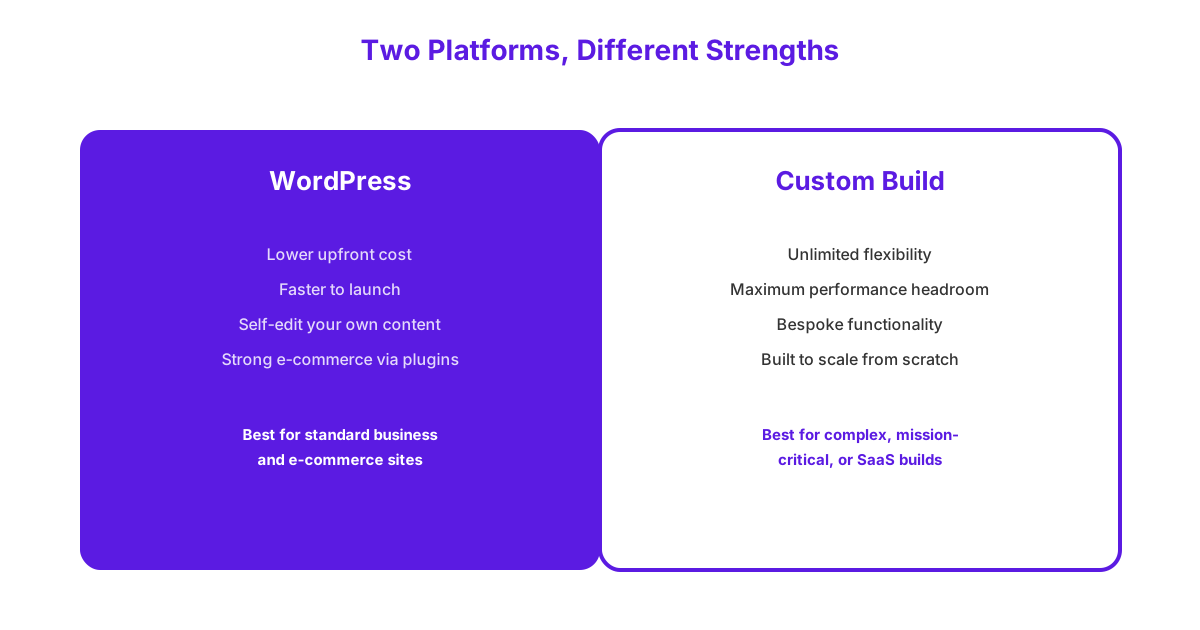
Comparing the two approaches side by side makes the practical tradeoffs clearer than describing them separately, since neither option wins across every single factor. The table below breaks down how WordPress and custom development compare across the factors that matter most when making this decision.
| Factor | WordPress | Custom Website |
|---|---|---|
| Initial Cost | Generally lower | Generally higher |
| Development Time | Faster, often weeks | Longer, often months |
| Flexibility | High, within plugin and theme ecosystem | Unlimited, built specifically to spec |
| Maintenance | Requires regular updates, largely manageable in-house | Requires ongoing developer involvement |
| Scalability | Good, with some limits at very high complexity | Excellent, built to scale from the ground up |
| SEO Control | Strong, with well-established plugins and practices | Strong, with full control over technical implementation |
| Security | Requires diligent updates and plugin management | Depends entirely on the quality of the custom build |
| Design Uniqueness | Good, though built on existing theme foundations | Complete, entirely bespoke design and structure |
| Ongoing Costs | Generally lower, hosting and occasional plugin fees | Generally higher, ongoing developer retainer often needed |
What Factors Should You Consider Before Choosing?
The factors that matter most when choosing between WordPress and a custom build are your budget and timeline, your business goals, your performance requirements, your SEO needs, your e-commerce plans, mobile experience expectations, and your appetite for ongoing maintenance. Working through each of these honestly, rather than defaulting to whichever option sounds more impressive, produces a far better decision than guessing.
Budget and Timeline
Budget and timeline considerations generally favour WordPress for businesses needing a working website within weeks rather than months, and for those with a more constrained upfront budget. A WordPress build typically costs meaningfully less upfront than a comparable custom site, since much of the underlying system already exists and doesn’t need to be built from scratch. A custom build, while more expensive and slower to launch, may still be the right call despite this if the business’s specific needs genuinely justify that additional investment and timeline.
Business Goals and Growth Plans
Business goals and growth plans matter because a straightforward business website with standard needs, such as service pages, a blog, and a contact form, rarely benefits from custom development’s additional cost and complexity. A business planning significant, unusual growth, such as building a bespoke customer portal or a complex booking system unlike anything an existing plugin handles well, may find that WordPress’s constraints become a genuine limitation as those plans materialise. Matching the platform choice to realistic, specific growth plans, rather than a vague sense that “we might need something more advanced someday,” produces a more grounded decision.
Website Speed and Performance
Website speed and performance can favour either approach depending entirely on the quality of the build, since a poorly optimised custom site can load just as slowly as a bloated, plugin-heavy WordPress site. A well-built WordPress site, using a lean theme and a sensible, minimal set of plugins, can achieve genuinely excellent load times and Core Web Vitals scores. A custom build has the potential for even greater performance headroom, since there’s no underlying platform overhead at all, but this potential is only realised if the custom code itself is written well, which isn’t guaranteed simply by choosing the custom route.
SEO Requirements
SEO requirements can be met well by either WordPress or a custom build, provided the technical implementation, whichever platform is chosen, is done correctly from the outset. WordPress benefits from mature, well-established SEO plugins that handle metadata, sitemaps, and schema markup with minimal technical effort required from the business owner. A custom build offers equally strong SEO potential through direct, hands-on technical control, but this requires deliberate implementation rather than relying on an existing plugin to handle it automatically. Whichever platform you choose, it’s worth building the site with our web design service as a website built with SEO in mind from the outset, rather than treating technical SEO as an afterthought layered on after launch.
E-Commerce Needs
E-commerce needs are generally served very well by WordPress through WooCommerce for small to medium online stores with fairly standard product catalogues and checkout requirements. Businesses with more complex e-commerce needs, such as highly customised checkout flows, unusual inventory logic, or deep integration with bespoke internal systems, may find that a custom build better accommodates these specific requirements without working around an existing platform’s assumptions. Most small Irish businesses selling a reasonably standard range of products online are well served by WordPress and WooCommerce without needing to consider custom development at all.
Mobile-Friendliness and User Experience
Mobile-friendliness and user experience quality depend on the specific theme or code implementation rather than the underlying platform choice itself, since both WordPress and custom builds can produce excellent or poor mobile experiences depending on execution. A well-chosen, modern WordPress theme delivers a genuinely strong, responsive mobile experience out of the box. A custom build offers more granular control over exactly how mobile interactions behave, which matters most for businesses with specific, unusual interaction requirements rather than a standard browsing and contact-form experience.
Maintenance and Long-Term Support
Maintenance and long-term support requirements differ meaningfully between the two approaches, with WordPress generally requiring more frequent but more manageable updates, and custom builds requiring less frequent but more specialised developer involvement. WordPress needs regular core, theme, and plugin updates to stay secure, a task many business owners handle themselves or delegate to a low-cost maintenance retainer. A custom build has no equivalent plugin ecosystem to update, but any changes or fixes require a developer familiar with that specific codebase, which can create more dependency on a particular provider over time.
When Is WordPress the Right Choice?
WordPress is the right choice for businesses wanting to manage their own content independently, needing standard e-commerce functionality, running a fairly typical business website, or working within a more constrained budget. These situations cover the large majority of small and medium Irish businesses, which is exactly why WordPress powers such a significant share of business websites globally.
Situations Where WordPress Wins
WordPress wins clearly for businesses that want to add and edit their own content regularly without depending on a developer for every small change, since its editing interface is specifically designed for non-technical users. It also wins for businesses needing standard e-commerce functionality through WooCommerce, covering the majority of small to medium online stores without requiring custom development. A standard business website, covering service pages, a blog, and a contact form without unusual technical requirements, is very well served by WordPress’s existing structure and mature ecosystem.
Budget-conscious businesses also tend to be well served by WordPress, since its lower upfront cost and faster development timeline make it accessible to businesses that couldn’t justify a larger custom development budget. None of these situations represent settling for something lesser. Each is a case where WordPress’s specific strengths align directly with what the business actually needs.
When Is a Custom Build the Right Choice?
A custom build is the right choice when performance is genuinely critical to the business, when functionality needs are complex or bespoke beyond what existing plugins handle well, when building a SaaS product or web application rather than a standard business website, or when long-term scalability at significant complexity matters. These situations are less common than standard WordPress use cases, but they represent genuine, well-justified reasons to choose custom development rather than working around WordPress’s constraints.
Situations Where Custom Development Wins
Custom development wins clearly when website performance is mission-critical, such as for a business where even small delays in load time directly and measurably affect revenue, since a lean, purpose-built codebase can achieve performance headroom that a plugin-reliant setup cannot fully match. Independent benchmarking, such as Google’s own Core Web Vitals research, shows that lean, purpose-built code generally outperforms heavier, plugin-reliant setups on load speed, reinforcing that this performance advantage is a genuine, measurable factor rather than a marketing claim for custom development. Complex or bespoke functionality, such as a highly specific booking system, an unusual internal integration, or functionality genuinely unlike anything an existing plugin offers, also points clearly toward custom development, since forcing this kind of requirement into an ill-fitting existing plugin often produces a worse result than building it correctly from scratch.
Building a SaaS product or a genuine web application, rather than a standard content-driven business website, virtually always calls for custom development, since these products have fundamentally different technical requirements than a WordPress site was designed to serve. Long-term scalability at significant complexity, such as a business anticipating very high traffic volumes or deeply complex data structures, also favours custom development’s unlimited architectural flexibility over WordPress’s more constrained, if still substantial, scaling ceiling. Businesses without these specific, justified needs are usually better served by our small business website packages built on WordPress, rather than paying for custom development’s additional cost and complexity without a genuine corresponding need.
Can You Start With WordPress and Move to Custom Later?
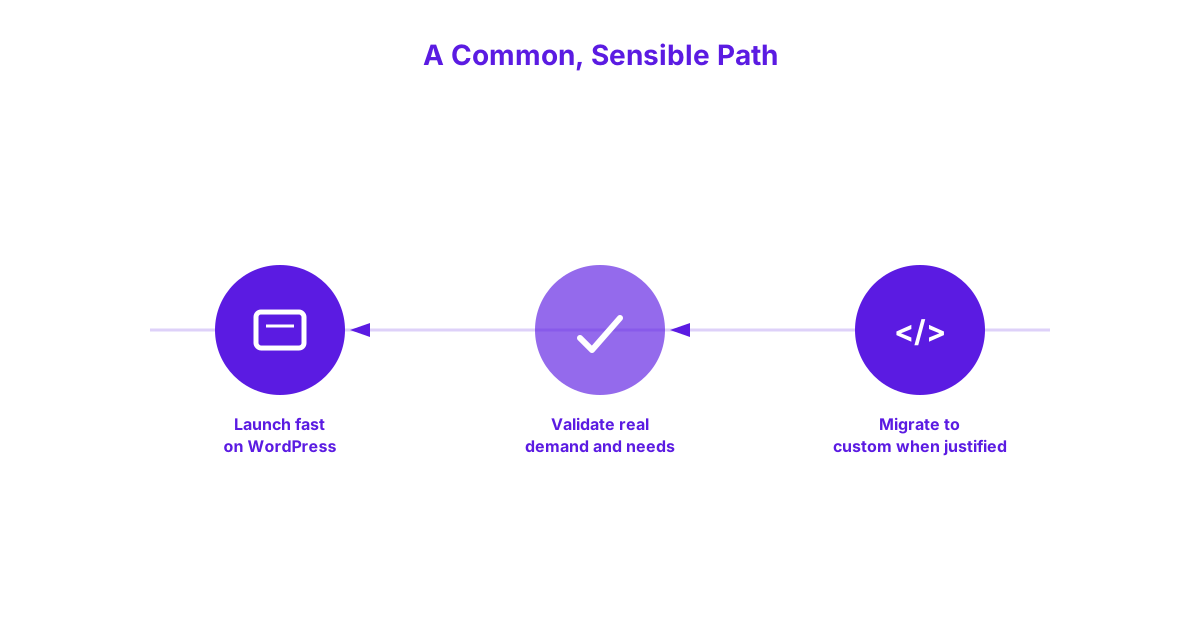
Yes, starting with WordPress and moving to a custom build later is a common and often genuinely sensible path, particularly for businesses uncertain about their long-term complexity needs at launch. This sequencing lets a business move quickly and affordably at first, validating real demand and specific functionality needs before committing to the larger investment a custom build requires.
Many businesses start on WordPress specifically to launch quickly and start generating revenue or leads, then migrate to a custom build once their traffic, complexity, or functionality needs have grown enough to genuinely justify that additional investment. This path avoids the risk of over-investing in custom development for needs that may never fully materialise, while still leaving the custom option open once real, validated demand justifies it. A business that outgrows WordPress after two or three years of genuine, evidenced growth is in a considerably stronger position to specify exactly what a custom build needs to do than one guessing at those requirements from day one.
What’s Actually Changing in Web Development Right Now?
Several trends are currently reshaping how both WordPress and custom websites get built, worth understanding as context even without needing deep technical knowledge of any of them. Headless CMS setups, where the content management backend is separated from the actual website’s front-end display, are increasingly used to combine WordPress’s easy content editing with custom-built, highly optimised front-end performance, blurring the line between the two approaches covered in this guide. AI-assisted development workflows are also changing how quickly both WordPress themes and custom code can be built and modified, generally shortening development timelines across both approaches rather than favouring one over the other specifically.
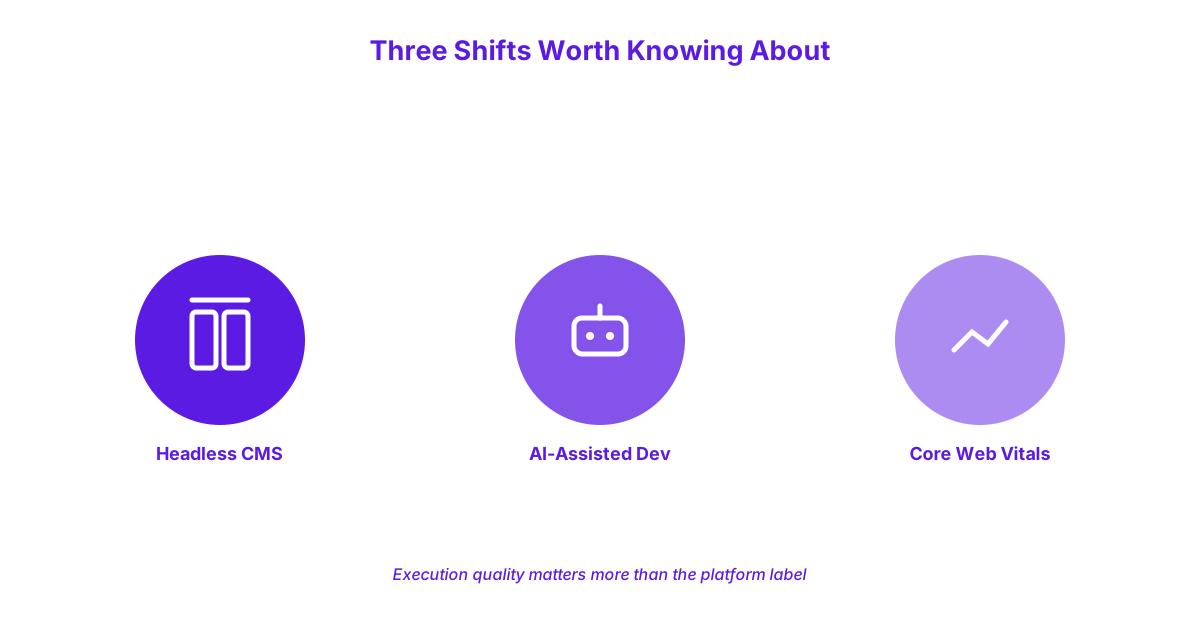
Core Web Vitals, Google’s specific measurements of loading speed, interactivity, and visual stability, continue to carry growing weight in search rankings, making performance optimisation increasingly important regardless of which platform a business chooses. This trend reinforces a theme running throughout this entire guide: execution quality increasingly matters more than the underlying platform choice itself, and both WordPress and custom development can meet or fail these modern performance standards depending entirely on how well the build is actually done.
WordPress vs Custom Website at a Glance
The table below condenses the core decision points covered throughout this guide as a quick reference before making a final decision.
| Factor | Points Toward WordPress | Points Toward Custom |
|---|---|---|
| Budget | Limited or moderate | Larger, justified by specific needs |
| Timeline | Needed within weeks | Can accommodate months |
| Content Management | Want to self-edit regularly | Developer-managed changes acceptable |
| Functionality | Standard business or e-commerce needs | Complex, bespoke, or unusual requirements |
| Performance Needs | Standard, achievable with good WordPress practices | Mission-critical, maximum possible headroom needed |
| Growth Plans | Typical business growth | SaaS, web application, or very high scale |
Frequently Asked Questions
Is WordPress good for small businesses?
Yes, WordPress is genuinely good for small businesses, since it offers a strong balance of lower upfront cost, faster development, and the ability to manage content independently without ongoing developer dependency. It’s well suited to standard business websites and e-commerce needs, which covers the large majority of small business website requirements.
Is a custom website more secure than WordPress?
Not automatically, since security depends far more on the quality of the build and how diligently it’s maintained than on the underlying platform choice itself. A well-maintained WordPress site with regular updates can be genuinely secure, while a poorly built or poorly maintained custom site can be just as vulnerable, if not more so.
How much does a custom website cost compared to WordPress?
A custom website generally costs meaningfully more than a comparable WordPress build, often several times the price, due to the additional development time and bespoke work involved. The exact gap depends heavily on the specific functionality required, since a simple custom site and a highly complex one differ enormously in cost themselves.
Can I switch from WordPress to a custom website later?
Yes, switching from WordPress to a custom website later is a common and often sensible path, particularly once a business has validated real demand and specific functionality needs that WordPress can no longer accommodate well. This approach lets a business avoid over-investing in custom development before genuinely justified needs have materialised.
Is WordPress suitable for e-commerce?
Yes, WordPress is genuinely suitable for e-commerce through the WooCommerce plugin, which handles product catalogues, cart functionality, and payment processing for a substantial share of small to medium online stores. Businesses with more complex or unusual e-commerce requirements may eventually outgrow this setup, but it comfortably serves the majority of standard online store needs.
Choosing between WordPress and a custom build matters less, in the end, than who actually builds it and how well the work is done. A thoughtfully built WordPress site will outperform a poorly executed custom build every time, and the reverse is just as true. If you’d like an honest recommendation based on your specific business rather than a platform preference decided in advance, get in touch and talk to us about the right approach for your business.
