

A Dublin plumbing company dropped from the top three in the map pack to page two overnight. Nothing changed on their end: same reviews, same website, same phone number. What changed was Google’s weighting of signals most business owners never think to check.
Local rankings in 2026 are shaped by more moving parts than ever, and treating your Google Business Profile as a “set it and forget it” listing is one of the fastest ways to lose visibility. This article breaks down every factor that actually moves rankings this year, backed by what the data and Google’s own guidance tell us, so you know exactly where to focus your time.
How Does Google’s Local Ranking Algorithm Actually Work in 2026?
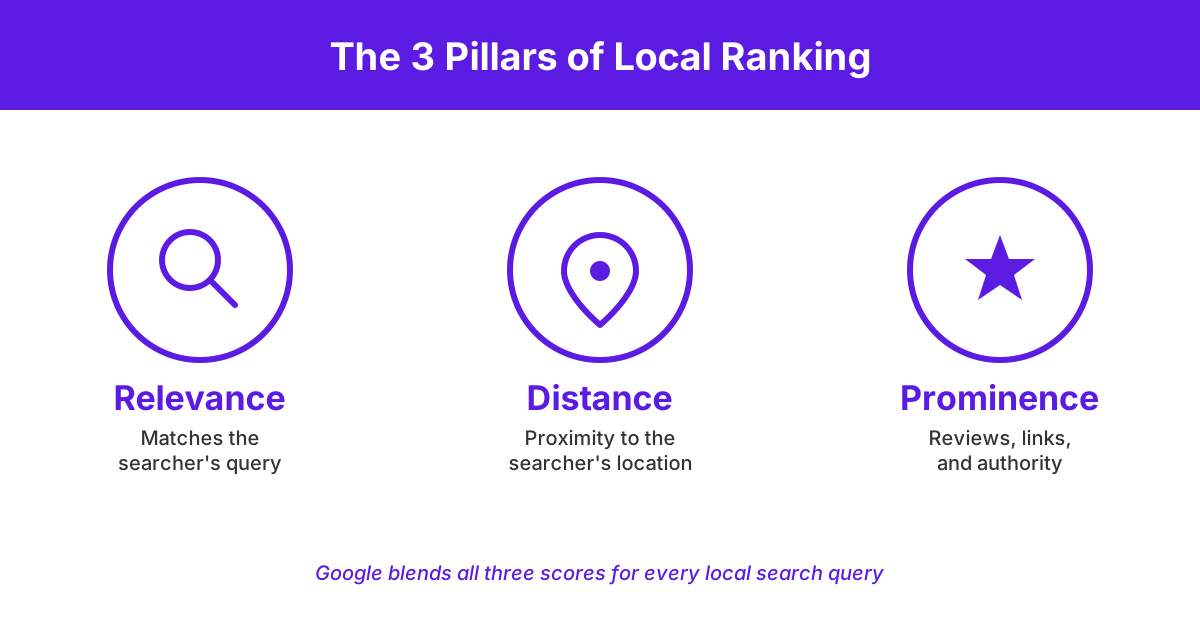
Google’s local ranking algorithm works by scoring every eligible business against three core pillars: relevance, distance, and prominence, then blending those scores to decide who appears in the map pack and local organic results. Relevance measures how well your business profile and website match what the searcher typed. Distance measures physical proximity between the searcher (or the location they specified) and your business address.
Prominence is the pillar that has grown the most in weight since 2024. It covers review volume and quality, backlink authority, citation consistency, and increasingly, how often AI systems and knowledge panels reference your business as an authoritative source. A business a few kilometres further away can still outrank a closer competitor if its prominence signals are significantly stronger. The practical takeaway: you cannot out-optimise distance, but you can out-optimise everyone on relevance and prominence.
Is Your Google Business Profile Still the #1 Local Ranking Factor?
Yes, your Google Business Profile is still the single most influential local ranking factor in 2026, though its dominance has narrowed slightly as website and AI-visibility signals gain weight. GBP remains the fastest lever you can pull because Google trusts data it controls directly more than data it has to infer from your website. A fully optimised profile with accurate categories, complete attributes, and regular activity consistently outperforms a neglected one, even when the neglected business has a stronger website.
Primary Category and Service Selection
Your primary GBP category is the single strongest relevance signal Google uses to match your business to a search query. Choosing the closest possible match, rather than the broadest one, directly affects which searches you appear for. A business that lists itself as “Marketing Agency” instead of “Digital Marketing Consultant” will lose visibility on more specific, higher-intent searches.
Secondary categories and the services section reinforce this signal but do not override it. Add every service you genuinely offer, with unique descriptions rather than copy-pasted boilerplate, since Google indexes this text and uses it for query matching. Review your category selection quarterly, since Google periodically updates and merges category options.
Photo and Post Update Frequency
Businesses that upload new photos and publish GBP posts at least weekly see measurably higher engagement rates on their profile, which feeds back into Google’s activity and prominence signals. Static profiles with photos from years ago signal to both users and Google’s systems that the business may be inactive or less trustworthy. Fresh, geotagged photos of your actual premises, team, and completed work carry more weight than stock imagery.
GBP posts should not be treated as a social media afterthought. Posts with a clear call to action and a relevant image get more clicks, and consistent posting cadence correlates with better local pack visibility over a rolling 90-day window. Aim for at least one post per week and one new photo batch per month.
How GBP Signals Compare to Everything Else
GBP optimisation alone will not overcome a weak website or a thin review profile, since Google now cross-references signals across all three prominence sources before ranking a business. The table below shows how the major signal categories compare in relative influence based on current local ranking factor research and observed ranking behaviour.
| Signal Type | Relative Weight | Notes |
|---|---|---|
| GBP Signals (categories, posts, photos, Q&A) | High | Fastest to improve, most directly controlled by the business |
| Reviews (volume, recency, sentiment) | High | Compounds over time, hardest to fake convincingly |
| On-page and Website Signals (content, schema, UX) | Medium-High | Growing in weight as AI systems crawl websites directly |
| Citations and NAP Consistency | Medium | Foundational, but a smaller differentiator among established businesses |
| Backlinks and Off-site Authority | Medium | Slower to build, strongest long-term compounding effect |
Do Reviews Really Matter More Than Star Ratings Now?
Yes, review recency, volume, and sentiment now matter more to local rankings than the raw star rating average. A 4.6-star profile with steady new reviews and detailed responses will often outrank a 4.9-star profile that has not received a new review in six months. Google reads the pattern of activity, not just the final number.

Review Recency vs. Review Volume
Review recency is now a stronger ranking signal than total review volume, meaning a business with 40 reviews and steady monthly activity can outrank a competitor with 200 reviews and no new activity in over a year. Google’s systems appear to weight the trailing 90 to 180 days of review activity heavily when assessing whether a business is currently active and trustworthy. A large historical review count still matters for baseline trust, but it stops being a competitive advantage once it goes stale.
The practical implication is simple: a steady drip of five to ten new reviews per month outperforms a one-off push to get fifty reviews in a single week. Irish businesses relying on review volume alone from a launch campaign years ago are the ones most likely to see unexplained ranking drops.
Why Owner Responses Are a Ranking Signal, Not Just PR
Responding to reviews, both positive and negative, functions as a direct ranking signal because it demonstrates active account management to Google’s systems. Profiles with a high response rate to reviews show measurably better engagement metrics than profiles that never reply. This is not just reputation management, it is a technical signal read alongside your posting frequency and photo uploads.
Responses should be specific rather than templated. A response that references the actual service used and includes a natural keyword mention (without stuffing) reinforces relevance in addition to prominence. Negative reviews handled professionally and promptly also reduce the reputational damage that would otherwise suppress click-through rate from the map pack.
How Google Reads Review Sentiment (Not Just Numbers)
Google’s systems now parse the actual text content of reviews to extract sentiment and topic relevance, not just the numeric star rating attached to each one. Reviews that mention specific services, locations, or outcomes (“fixed our boiler within a day in Tuam”) reinforce both local relevance and service relevance simultaneously. This is why encouraging detailed, specific reviews matters more than encouraging star ratings alone.
Sentiment analysis also means a string of short, generic five-star reviews carries less weight than a smaller number of detailed, specific ones. Businesses should prompt customers with a question or two rather than a blank request for “a review,” since this naturally produces more descriptive, keyword-relevant text.
Is NAP Consistency Still Worth Worrying About in 2026?
Yes, NAP (name, address, phone number) consistency across the web is still worth actively monitoring in 2026, even though it has become a baseline expectation rather than a competitive differentiator. Inconsistent NAP data does not typically tank an established business’s rankings outright, but it does slow down trust-building for newer listings and can quietly suppress prominence signals over time.
Where Citation Errors Actually Come From
Most citation errors originate from old directory listings, defunct business profiles, or outdated aggregator data that was never corrected after a business moved, rebranded, or changed its phone number. A single incorrect listing on a low-authority directory rarely causes damage on its own, but the same error propagated across dozens of scraped directories creates a pattern of conflicting signals. Google’s systems weigh the majority and recency of matching data points, so a handful of stale citations usually will not overrule a large body of correct, recent ones.
The businesses most affected are those that have moved premises, changed phone providers, or merged with another company without a structured citation cleanup afterward. Running a citation audit after any of these events should be standard practice, not an afterthought.
Data Aggregators vs. Manual Directory Listings
Correcting data at the aggregator level (the handful of data providers that feed hundreds of smaller directories) is far more efficient than manually updating each individual directory listing one by one. Aggregators like Data Axle and Foursquare’s data partners redistribute your business information downstream, so a single correction upstream can cascade through dozens of directories automatically over the following weeks. Manual directory-by-directory correction is still worthwhile for high-authority, high-traffic directories, but should be treated as a secondary pass, not the primary strategy.
According to Whitespark’s annual Local Search Ranking Factors survey, citation accuracy and consistency continue to be cited by experienced local SEO practitioners as a persistent trust signal, even as its relative influence has been overtaken by GBP signals and reviews. It remains foundational groundwork rather than a growth lever.
Is Your Website Helping or Hurting Your Google Rankings?
Your website can actively hurt your rankings if it consists of thin, templated location pages, slow load times, or missing structured data, even if your GBP and reviews are strong. Google increasingly cross-references what your website says about your business against what your GBP profile claims, and a mismatch or a weak website undermines trust in the entire profile.
Location Pages That Actually Rank vs. Templated Doorway Pages
A location page ranks when it contains genuinely unique content about that specific area, such as local landmarks, area-specific case studies, or region-specific pricing context, rather than the same paragraph with the town name swapped out. Google’s algorithms are specifically tuned to detect and demote doorway pages, which are location pages that exist purely to capture search traffic without offering unique value to the visitor. A business with ten near-identical location pages is often better off consolidating into three or four genuinely differentiated pages.
The difference shows up clearly in practice. A well-built local page that includes area-specific client results, local landmarks, and genuinely useful information for that market will consistently outrank five templated pages covering nearby towns with copy-pasted structure. Quality and specificity beat quantity every time this gets tested.
Mobile Experience and Core Web Vitals
Mobile page speed and Core Web Vitals scores directly affect local rankings because the overwhelming majority of local searches happen on mobile devices, and Google’s local algorithm factors in user experience signals alongside relevance and prominence. Pages that load in under 2.5 seconds on mobile and pass Core Web Vitals thresholds for interactivity and visual stability see measurably lower bounce rates from local search traffic. A slow location page can lose the ranking advantage that its content otherwise deserves.
This is a technical issue as much as a content one. Compressing images, minimising third-party scripts, and using a lightweight page template for location and service pages specifically will do more for local rankings than most businesses expect from a technical fix.
Schema Markup: What Google Actually Reads
Schema markup helps Google confirm and reinforce the facts already stated on your GBP profile, such as your address, hours, services, and reviews, by providing the same data in a machine-readable format on your website. LocalBusiness schema, Service schema, and review schema are the three types with the clearest local SEO impact. Google uses this data to cross-verify your GBP claims rather than to discover new information, which is why consistency between your schema and your GBP listing matters more than the schema’s mere presence.
FAQ schema and Service schema also feed directly into how AI systems extract and cite information about your business, which is a growing consideration covered further below. Sites without any structured data are not automatically penalised, but they are giving up a free trust-reinforcement signal that costs very little developer time to implement.
Does Publishing More Local Content Actually Improve Map Pack Rankings?
Publishing more local content improves map pack rankings only when that content builds genuine topical authority around your services and area, not simply when more pages exist. Volume without depth does not move the needle, and in some cases dilutes your site’s overall relevance signal by surrounding strong pages with weak ones.
Topical Authority vs. Thin Location Pages
Topical authority is built by comprehensively covering a subject area across multiple connected pages and articles, rather than by publishing many shallow pages targeting slightly different keyword variations. A site with one detailed, 2,000-word guide to a service plus three supporting articles that answer related questions will typically outrank a site with ten thin, 300-word pages targeting near-identical keywords. Google’s systems increasingly reward depth and internal linking structure between related content over sheer page count.
Businesses serious about ranking beyond their home town should invest in a proper local content strategy that connects service pages, location pages, and supporting blog content into a coherent topical cluster, rather than treating each page as an isolated asset. This is the difference between content that compounds in authority over time and content that sits stagnant with near-zero clicks.
How Often You Should Realistically Be Publishing
For most small to medium local businesses, publishing one genuinely useful, well-researched piece of content every two to three weeks produces better long-term ranking results than publishing weekly filler content. Consistency matters more than frequency, since Google’s systems track publishing patterns over months, not days. A realistic, sustainable cadence that a business can maintain for a year outperforms an aggressive burst that stalls after two months.
Quality control also matters more as publishing frequency increases. Businesses should prioritise updating and expanding existing underperforming pages before creating entirely new ones, since a page currently generating near-zero clicks often has more upside potential than a brand new page starting from nothing.
What Does AI Mode Mean for Local Businesses in 2026?
AI Mode and AI Overviews mean local businesses now need to optimise for being cited as a direct answer inside an AI-generated response, not just for ranking in a traditional list of blue links. Google’s AI Mode, along with tools like ChatGPT and Perplexity, increasingly answers local queries directly within the chat interface, sometimes bypassing the traditional map pack and search results page entirely. Businesses that structure their content and data for extraction are more likely to be the source an AI system cites or recommends.
How ChatGPT, Perplexity, and AI Overviews Pull Local Recommendations
AI systems pull local business recommendations primarily from a combination of structured data (schema markup and knowledge graph entries), review platform data, and content that directly and clearly answers a specific question in its opening sentence. Unlike traditional ranking algorithms, these systems are not just matching keywords, they are extracting and synthesising factual claims from multiple sources to construct a single answer. A business whose website content, GBP profile, and third-party mentions all say the same thing consistently is far more likely to be surfaced as a trustworthy source.
This is why content structured with clear, standalone answers under question-based headings performs better in AI-driven search than content written in a traditional narrative style. AI systems favour content they can extract cleanly without needing to interpret surrounding context, which rewards direct, factual writing over marketing-style prose.
What Structured Data Signals AI Models Actually Use
AI models draw most heavily on LocalBusiness schema, Service schema, FAQ schema, and review schema when constructing answers about local businesses, since these formats provide clearly labelled, machine-readable facts rather than requiring inference from prose. A business with complete, accurate schema markup across its site gives AI systems a higher-confidence dataset to cite from, compared to a business whose facts are scattered across unstructured paragraphs. This does not guarantee a citation, but it removes one of the most common reasons a business gets skipped over: ambiguous or missing structured facts.
Businesses should treat schema markup as an ongoing maintenance task rather than a one-time setup. Address changes, new services, and updated pricing all need to be reflected in schema promptly, since outdated structured data can actively mislead an AI system into citing incorrect information about your business.
Do Backlinks Still Matter for Local SEO, Or Is That Old Thinking?
Yes, backlinks still matter for local SEO in 2026, and remain one of the strongest long-term prominence signals, but the type of link matters far more than it used to. A handful of genuinely relevant local links now outweighs dozens of generic, low-quality directory submissions that were common in older link-building strategies.
Quality Local Links vs. Generic Directory Spam
A link from a genuinely relevant local source, such as a chamber of commerce, a local news outlet, or an industry association, carries significantly more ranking value than a link from a generic, low-authority business directory with no editorial standards. Google’s systems have become better at identifying and discounting link farms and mass-submitted directory links, meaning strategies built purely around volume of citations now produce diminishing returns. A single feature in a regional publication can outweigh fifty low-quality directory submissions combined.
This shift means link-building budgets are better spent on relationship-driven outreach and genuine local partnerships than on bulk directory submission services. The latter is not actively harmful in most cases, but it is an inefficient use of time and money compared to the alternative.
Where Real Authority Signals Come From in 2026
Real authority signals in 2026 come primarily from earned media coverage, genuine local partnerships, industry association memberships, and organic mentions from other businesses and customers, rather than from purchased or manually submitted links. A business sponsoring a local event, being quoted in a regional news story, or being referenced by another local business’s blog post builds the kind of link profile that compounds in value over years. These signals are harder to build quickly, which is exactly why they carry more weight: they are harder to fake.
Local SEO Ranking Factors at a Glance
Local rankings in 2026 are decided by a combination of controllable, fast-moving signals and slower, compounding ones, and the table below summarises where to focus effort first.
| Factor | Why It Matters | Action Item |
|---|---|---|
| GBP Optimisation | Fastest, most direct ranking lever Google controls | Audit categories, services, and posting cadence monthly |
| Review Recency and Sentiment | Signals active, trustworthy business over time | Build a steady monthly review request process |
| NAP Consistency | Foundational trust signal, prevents suppression | Run a citation audit after any business detail changes |
| Website Content and Location Pages | Differentiates you from doorway-page competitors | Replace templated pages with unique, area-specific content |
| Schema Markup | Reinforces GBP claims and feeds AI answer engines | Implement LocalBusiness, Service, and FAQ schema site-wide |
| Topical Content Authority | Compounds ranking strength over months, not days | Publish one deep, useful piece every two to three weeks |
| Backlinks and Local Authority | Slowest to build, strongest long-term compounding signal | Prioritise genuine local partnerships over directory submissions |
Frequently Asked Questions
What’s the most important local SEO ranking factor in 2026?
Google Business Profile optimisation remains the single most important local ranking factor in 2026, ahead of reviews, website content, and backlinks. It is the fastest and most direct signal Google controls, which is why a fully optimised profile with accurate categories and regular activity consistently outperforms a stronger website with a neglected GBP.
How many reviews do you need to rank in the local pack?
There is no fixed review count required to rank in the local pack, since recency and consistency matter more than raw volume. A business with 40 reviews and steady monthly activity commonly outranks a competitor with 200 stale reviews and no recent activity.
Does NAP consistency really affect local rankings?
NAP consistency affects local rankings indirectly by supporting trust rather than by directly boosting position on its own. Inconsistent business information across directories slows down trust-building for newer listings and can suppress prominence signals, but it rarely causes a ranking collapse on its own for an established business.
Do social media mentions help local SEO?
Social media mentions provide a modest indirect benefit to local SEO by contributing to overall online prominence and occasionally driving referral traffic, but they are not a direct ranking factor Google confirms using. Their main value lies in supporting brand consistency and generating the kind of engagement that can lead to reviews, links, and citations.
How does Google decide who ranks in the Local Pack?
Google decides Local Pack rankings by scoring each eligible business on relevance, distance, and prominence, then blending those three scores for each individual search query. A business further from the searcher can still outrank a closer one if its prominence signals, such as reviews and backlinks, are significantly stronger.
Ranking in 2026 comes down to consistency across every signal Google and AI systems can see: your profile, your reviews, your website, and your backlink profile all need to tell the same accurate story. If you’d rather have an experienced team audit where your local presence is losing ground and fix it systematically, get in touch with Magnitu Digital and we’ll show you exactly where the gaps are.