How Much Should You Budget for Google Ads in Ireland?
“How much do I actually need to spend?” is the exact question every Irish business owner asks before starting Google Ads, and most generic advice online dodges it with vague reassurance instead of a real answer. There’s no single magic number that fits every business, but there are clear, sensible budget tiers depending on your goals and how competitive your market is. This guide gives you concrete euro ranges, a practical calculation method, and real, clearly sourced Irish market cost data rather than borrowed US or UK figures dressed up as local ones.
How Much Should an Irish SME Spend on Google Ads Overall?
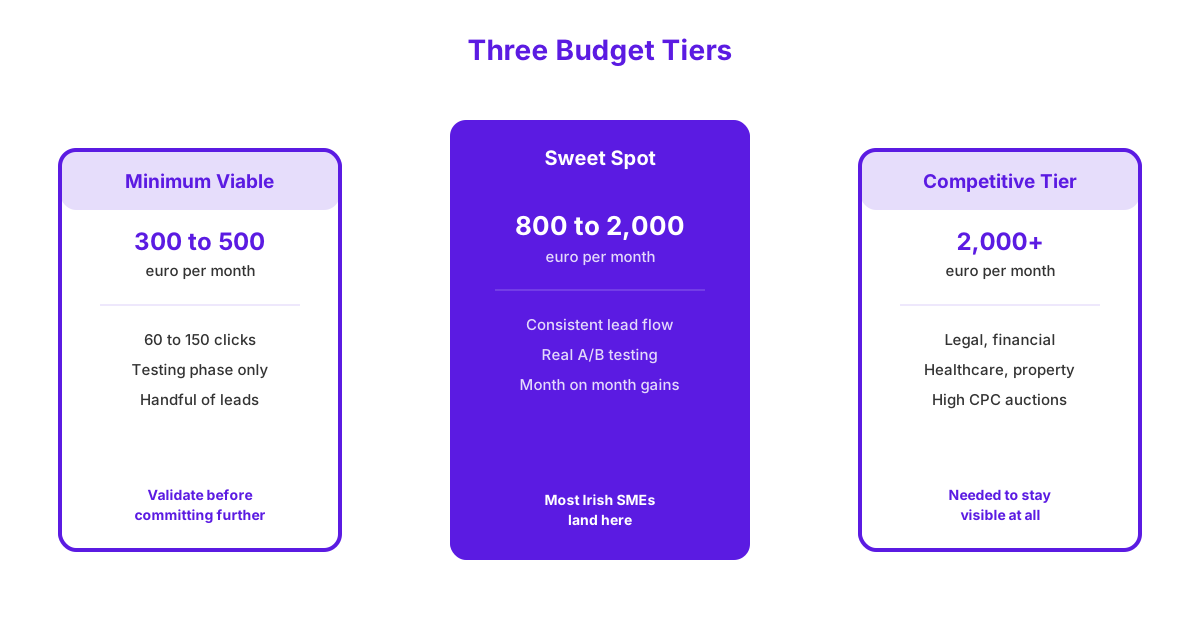
Most Irish SMEs should budget somewhere between 300 and 2,000-plus euros per month on Google Ads, depending on their specific goals and how competitive their industry is. A business testing the waters with a low-competition, local service has very different needs than one competing in a crowded national market like legal services or financial advice. This guide breaks that range into three practical tiers: a minimum viable testing budget, a sweet spot most SMEs should aim for, and a higher tier needed specifically in genuinely competitive sectors.
Each tier below is described honestly in terms of what it actually gets you, not inflated to make a bigger number sound more attractive. The right tier for your business depends on matching your budget to your actual competitive reality, which the sections ahead will help you work out.
What Can You Expect From a Minimum Viable Google Ads Budget?
A minimum viable Google Ads budget gets you a genuine testing phase rather than meaningful, sustained growth, and should be understood as exactly that from the outset. This tier is a legitimate starting point for businesses wanting to validate the channel before committing further, not a long-term growth strategy.
What 300 to 500 Euro Per Month Actually Gets You
A budget of 300 to 500 euros per month typically buys somewhere between 60 and 150 clicks, depending on your industry’s average cost per click, which is enough to generate a handful of leads but not enough to properly test multiple keywords or ad variations simultaneously. This tier works as a genuine testing budget: enough to see whether Google Ads can generate any relevant enquiries for your business at all, but not enough to draw strong conclusions about what’s working versus what isn’t within any single month. Businesses in competitive sectors, such as legal or financial services, will see this budget exhausted very quickly, often producing single-digit clicks per day.
This tier is best suited to genuinely low-competition local services or businesses specifically wanting to validate demand before committing to a larger spend. Treating this budget as a permanent strategy rather than a stepping stone typically leads to disappointment, since the sample size it produces each month is usually too small to optimise meaningfully or draw confident conclusions from.
What’s the Sweet Spot Budget for Most Irish SMEs?
The sweet spot budget for most Irish SMEs sits between 800 and 2,000 euros per month, since this range provides enough volume to generate a consistent lead flow while still allowing genuine testing and optimisation month over month. This is the tier where Google Ads starts to function as a reliable, ongoing growth channel rather than a limited experiment.
What 800 to 2,000 Euro Per Month Actually Gets You
A budget of 800 to 2,000 euros per month typically generates enough traffic and lead volume to run genuine A/B tests between ad variations and landing pages, since the larger sample size at this spend level allows real conclusions to be drawn within a single month rather than needing several months just to gather enough data. This range supports a consistent flow of leads for most local and regional Irish service businesses, providing enough breathing room to test different keyword groups without immediately running out of budget partway through the month. Most SMEs land in this tier once they’ve validated that the channel works and are ready to treat it as a genuine, ongoing part of their marketing mix.
This budget level also supports proper month-on-month optimisation, since enough data accumulates each month to identify which keywords, ad copy, and landing pages are actually converting versus which ones are quietly wasting spend. Businesses operating in moderately competitive markets, without facing the most expensive keyword categories, typically find this range sufficient to compete effectively rather than simply participating at the margins.
When Does a Bigger Google Ads Budget Make Sense?
A bigger Google Ads budget, generally 2,000 euros or more per month, makes sense specifically in highly competitive sectors where cost per click is significantly elevated and underspending risks near-total invisibility rather than just slower growth. This isn’t about spending more for its own sake; it’s about matching budget to the genuine cost of competing in certain markets.
Competitive Sectors That Need 2,000 Euros or More Per Month
Legal services, financial services, construction, healthcare, and property are the sectors most likely to require 2,000 euros or more per month to compete effectively in Google Ads, since these categories consistently show some of the highest cost-per-click figures in the Irish market. In these sectors, a business underspending relative to its competitors doesn’t just grow more slowly; it often becomes functionally invisible, since Google’s ad auction system means an under-resourced campaign may barely show at all for the most valuable, highest-intent search terms. A solicitor’s practice bidding 500 euros per month against competitors bidding 3,000 euros or more for the same keywords is not competing on a smaller scale; it’s largely absent from the auction for the terms that matter most.
The risk of underspending in these specific sectors is genuinely underappreciated: businesses often assume a smaller budget simply produces proportionally smaller results, when in highly competitive auctions it can instead produce close to zero visibility for the most valuable search terms. Businesses in these sectors should treat the 2,000 euro-plus tier as a realistic entry point for meaningful competition, not an aspirational stretch goal to work toward gradually.
How Much Does Google Ads Cost by Industry in Ireland?
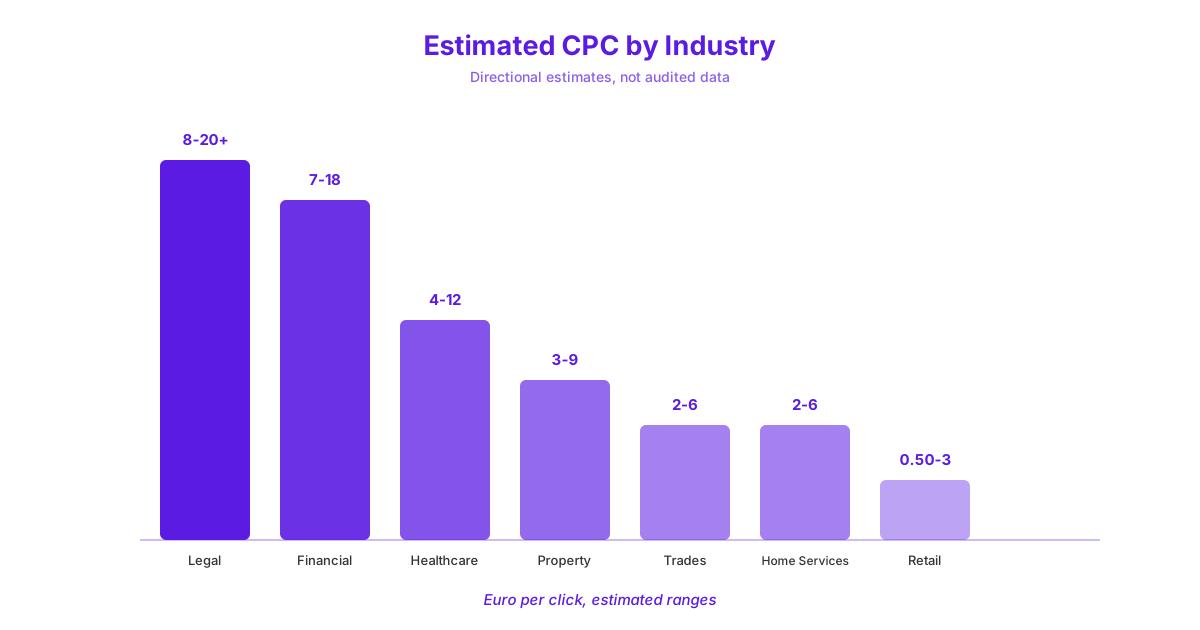
Google Ads costs vary significantly by industry in Ireland, with legal and financial services commanding the highest cost per click and lower-competition local trades typically costing considerably less. The table below gives estimated ranges based on observed patterns in the Irish market and general industry cost structures. These figures should be treated as directional estimates rather than verified, audited data, since comprehensive Irish-specific PPC benchmark studies are limited compared to the US and UK markets.
| Industry | Estimated Average CPC (Euro) | Competition Level |
|---|---|---|
| Legal Services | 8 to 20+ | Very High |
| Financial Services | 7 to 18 | Very High |
| Healthcare | 4 to 12 | High |
| Construction and Trades | 2 to 6 | Moderate |
| Property and Real Estate | 3 to 9 | High |
| Retail and E-Commerce | 0.50 to 3 | Moderate |
| Local Home Services | 2 to 6 | Moderate |
Where genuinely Irish-specific figures are limited, broader benchmark reports such as WordStream’s annual Google Ads benchmarks can offer useful international context, though costs in the Irish market often differ meaningfully from US or UK averages due to smaller search volumes and different competitive dynamics. Any business using this table to plan a budget should treat these as a starting reference point to validate against their own early campaign data, not as a guaranteed figure.
How Do You Calculate Your Own Google Ads Budget?
You calculate your own Google Ads budget by working backward from what a new customer is worth to your business and how many leads you typically need to close one sale. This approach produces a far more accurate, business-specific figure than simply picking a number from an industry average table.
Working Backward From Your Customer Value and Close Rate
Start with your average customer value, meaning the typical revenue a single new customer generates, either from one transaction or across their expected relationship with your business. Next, apply your realistic close rate, meaning the percentage of leads or enquiries that actually convert into paying customers, which for most Irish SMEs falls somewhere between 15% and 30% depending on the sales process involved. Dividing your target number of new customers by this close rate tells you how many leads you actually need to generate to hit that goal.
From there, multiply your required lead count by a realistic cost per lead for your industry, which you can estimate from the industry CPC table above combined with a typical conversion rate from click to lead of roughly 3% to 8%. For example, a business needing 10 new customers per month at a 20% close rate needs 50 leads, and if each lead costs roughly 20 euro to generate based on your industry’s click costs and conversion rate, that points to a monthly budget of approximately 1,000 euro. This calculation gives you a defensible, business-specific starting figure rather than an arbitrary number borrowed from a generic recommendation.
Building In a Safety Net Before You Commit
Building in a safety net means budgeting at least 20% above your calculated figure to account for the learning period every new campaign goes through before performance stabilises. Google’s ad auction system takes time to gather enough data on your account to optimise delivery effectively, and early weeks typically show a higher cost per lead than the campaign will settle into once enough data has accumulated. A business calculating a precise 1,000 euro monthly need should realistically plan for 1,200 euro to avoid running out of budget before the campaign has had a fair chance to find its footing.
This safety margin also protects against the natural variability in any advertising auction, where costs can fluctuate week to week based on competitor activity and seasonal demand shifts. If managing this calculation and the ongoing adjustments it requires feels like more than you want to take on internally, our Google Ads management service is built specifically to handle this kind of budget planning and ongoing optimisation on a business’s behalf.
What Other Costs Do You Need to Plan For Beyond Ad Spend?
Beyond the ad spend itself, most businesses need to budget for agency management fees, VAT, and any account setup costs before their true total monthly investment becomes clear. Treating ad spend as the only line item in a Google Ads budget consistently leads to underbudgeting for the campaign’s actual total cost.
Management Fees and How Agencies Typically Charge
Agencies typically charge a management fee either as a flat monthly rate, commonly between 300 and 800 euro for small to medium accounts, or as a percentage of ad spend, usually somewhere between 10% and 20%. A flat fee tends to suit smaller ad budgets better, since a percentage-based fee on a modest spend may not adequately compensate for the actual time required to manage the account properly. A percentage-based fee tends to make more sense as ad spend grows, since the absolute management effort scales somewhat with a larger, more complex account.
Businesses should clarify upfront exactly what’s included in a management fee, such as ongoing keyword research, ad copy testing, landing page recommendations, and monthly reporting, since these can vary significantly between providers charging similar headline rates.
VAT and Account Setup Costs
VAT at the standard Irish rate of 23% typically applies to both ad spend charged through an Irish Google Ads account and any agency management fees, meaning the effective total cost is higher than the headline euro figures alone suggest. Some agencies also charge a one-time account setup fee, commonly ranging from 200 to 500 euro, covering initial account structure, conversion tracking installation, and first-round keyword research before campaigns go live. Businesses should ask specifically whether quoted figures are inclusive or exclusive of VAT before comparing quotes between providers, since this detail can otherwise make one quote look misleadingly cheaper than another.
What Are the Most Common Ways Irish Businesses Waste Google Ads Budget?
The most common ways Irish businesses waste Google Ads budget are running overly broad match keywords, targeting the wrong locations, and failing to add negative keywords that filter out irrelevant searches. Each of these mistakes silently drains budget on clicks that were never likely to convert in the first place.
Broad Match Keywords, Wrong Locations, and Ignored Negative Keywords
Broad match keywords, when used without careful monitoring, can trigger ads for loosely related searches that have little genuine buying intent, burning through budget on clicks unlikely to ever convert. Location targeting mistakes, such as accidentally targeting all of Ireland when a business only serves County Galway, waste spend on clicks from potential customers who could never actually become paying clients regardless of how well the ad itself performs. Ignoring negative keywords, meaning terms you deliberately exclude your ads from showing for, allows a campaign to keep paying for clicks from searches like “free” or “jobs” that indicate the searcher isn’t a genuine potential customer.
These three mistakes together commonly account for a significant share of wasted spend in poorly managed accounts, often 20% or more of total budget in accounts that haven’t been actively refined. Businesses without the internal time or expertise to catch and correct these issues on an ongoing basis are often better served by a dedicated Google Ads agency with professional campaign management, since these mistakes typically compound quietly over months rather than announcing themselves clearly.
How Long Before a Google Ads Budget Starts Showing Results?
Most Google Ads budgets need 60 to 90 days before performance genuinely stabilises and becomes a reliable indicator of the campaign’s true potential. The first month is typically the most expensive per lead, since Google’s system is still gathering data on which keywords, ads, and audiences actually convert for your specific business, and this learning period comes at a real cost before it pays off.
During this initial period, cost per lead is commonly 20% to 40% higher than what the same campaign settles into once enough data has accumulated to optimise delivery properly. This isn’t a sign of a poorly run campaign; it’s an inherent characteristic of how Google’s auction and machine learning systems work, since they need a meaningful volume of actual performance data before they can start making smarter, more efficient decisions about who to show your ads to. Businesses expecting month-one performance to represent the campaign’s long-term potential are working from an unrealistic baseline, and judging a campaign’s viability too early, before this stabilisation period completes, is one of the most common reasons businesses abandon Google Ads prematurely.
Google Ads Budgets in Ireland at a Glance
The table below condenses the three budget tiers covered in this guide into a single scannable reference.
| Budget Tier | Monthly Range (Euro) | What You Get | Best For |
|---|---|---|---|
| Minimum Viable | 300 to 500 | A genuine testing phase, limited data volume | Validating demand before committing further |
| Sweet Spot | 800 to 2,000 | Consistent lead flow, real A/B testing capability | Most Irish SMEs in moderately competitive markets |
| Competitive Tier | 2,000+ | Meaningful visibility in high-CPC auctions | Legal, financial, healthcare, construction, property |
Frequently Asked Questions
How much does Google Ads cost for a small business in Ireland?
A small business in Ireland typically needs to budget between 300 and 2,000-plus euro per month for Google Ads, depending on their industry’s competitiveness and their specific growth goals. Businesses in low-competition local sectors can start meaningfully at the lower end, while those in legal, financial, or healthcare sectors usually need the higher end of this range to compete effectively.
Is Google Ads worth it for small Irish businesses?
Yes, Google Ads is worth it for most small Irish businesses when the budget is matched realistically to their specific industry’s competitiveness and paired with proper conversion tracking. It becomes a poor investment specifically when businesses underspend relative to their sector’s actual competition or fail to track which clicks are genuinely converting into leads.
How long does it take for Google Ads to start working?
Google Ads typically takes 60 to 90 days to start showing stabilised, reliable performance, since Google’s systems need this period to gather enough data to optimise delivery effectively. The first month commonly shows a higher cost per lead than later months, which is a normal part of the learning process rather than a sign of a failing campaign.
Should I run Google Ads myself or use an agency?
Whether to run Google Ads yourself or use an agency depends mainly on your available time, existing PPC knowledge, and budget size, since larger, more competitive budgets generally benefit more from professional management than small testing budgets do. A business with a minimum viable budget and some time to learn can reasonably self-manage initially, while larger budgets in competitive sectors typically see better returns with dedicated professional management.
What is a good cost-per-click for an Irish SME?
A good cost per click for an Irish SME depends entirely on the industry, ranging from under 1 euro for some retail and e-commerce searches to 20 euro or more for the most competitive legal and financial services keywords. Rather than judging your CPC against a single universal benchmark, compare it specifically against your own industry’s typical range and your resulting cost per lead relative to your customer value.
Getting your Google Ads budget right from the start saves months of either underspending into invisibility or overspending without proper tracking to show for it. If you’d like help working out a realistic budget for your specific business and industry, get in touch and talk to us about your budget.
