Content Marketing 101: A Guide for Irish SMEs
Most Irish SME owners know they should be doing content marketing. Fewer know where to actually start, or what even counts as “content” beyond an occasional Facebook post. This guide cuts through the theory and gives you a practical, no-fluff introduction covering what content marketing actually is, what genuinely works for a small business, and how to build a simple system you can realistically maintain.
What Is Content Marketing, and What Isn’t It?
Content marketing is the practice of creating and sharing genuinely useful content, such as articles, videos, or guides, to earn the attention and trust of potential customers rather than paying to interrupt their attention with an ad. The core distinction is earned versus bought attention. A Google Ads campaign buys a spot in front of someone searching right now; a well-written blog post earns a spot in front of that same person by being useful enough that Google, and the person themselves, choose to find it.
This doesn’t mean content marketing and advertising are opposites or that you must choose one over the other, but they work fundamentally differently. Advertising stops producing results the moment you stop paying. Content marketing builds a library of assets that keep attracting visitors and building trust long after you published them, provided the content is genuinely useful rather than thinly disguised sales copy.
The core content types available to most SMEs are blog posts and website articles, case studies and customer stories, video content, email newsletters, and social media posts. Each of these serves a slightly different purpose and audience, and the sections below cover which ones are realistically worth your time as a small business.
Why Should Irish SMEs Bother With Content Marketing?
Irish SMEs should bother with content marketing because it offers lower competition than fighting national or international brands for the same paid ad space, meaningfully lower long-term cost than sustained advertising, and a compounding trust effect that ads simply can’t replicate. Most content gaps in local and regional Irish markets are wide open, since larger competitors often focus content efforts on national campaigns rather than the specific, practical questions local customers are actually asking.
Cost efficiency is the second major reason. A single well-researched blog post that takes a few hours to write can keep generating traffic and enquiries for years, while a Google Ads budget only produces traffic for as long as you keep paying for it. Over a two to three year horizon, a business publishing consistent, useful content typically ends up with a significantly lower cost per enquiry than one relying purely on paid channels.
Trust is the third reason, and it’s the hardest one to fake. A potential customer who reads three genuinely helpful articles from your business before ever contacting you arrives already trusting your expertise, which shortens the sales conversation and improves close rates. This kind of pre-built trust is something an ad simply cannot deliver in the same way, no matter how well-targeted it is.
What Types of Content Actually Work for a Small Business?
Blog posts, case studies, and short-form video are the three content types that consistently work best for small Irish businesses with limited time and budget. Each serves a different stage of a customer’s decision-making process, and using all three together covers most of what an SME actually needs.
Blog Posts and Website Articles
Blog posts and website articles work because they directly target the specific questions your potential customers are typing into Google, capturing them at the exact moment they’re looking for answers. A well-written article answering “how much does a website cost in Ireland” or “what to look for in an accountant” positions your business as the answer before a competitor even shows up in the search results. This is the single highest-leverage content type for most SMEs, since it directly feeds both search visibility and customer trust simultaneously.
The key requirement is genuine usefulness. An article that actually answers the question in plain language, with real numbers and specifics, outperforms a vague, marketing-heavy piece every time, both with readers and with Google’s ranking systems. Aim for depth over frequency: one genuinely thorough article per month beats four shallow ones.
Case Studies and Customer Stories
Case studies and customer stories work because they provide concrete proof that your business delivers results, which is more persuasive to a potential customer than any amount of self-description. A short write-up covering a real customer’s problem, what you did, and the specific outcome achieved gives prospective customers something tangible to evaluate rather than generic claims. These are particularly effective for service businesses like accountants, marketing agencies, or tradespeople, where the buying decision hinges heavily on trust and proven track record.
A good case study doesn’t need to be long. Three to four paragraphs covering the problem, the approach, and a specific measurable result is usually enough to be genuinely persuasive, and it’s far quicker to produce than most business owners assume.
Video and Social Content
Video and social content work best as a distribution and trust-building layer on top of your core written content, rather than as a replacement for it. Short videos explaining a service, showing work in progress, or answering a common customer question perform particularly well on platforms like Instagram and TikTok, where Irish audiences increasingly discover local businesses. This content type requires less polish than most business owners assume; a genuine, slightly imperfect video showing real work often outperforms an overly produced one.
Social posts summarising or teasing a blog post or case study also help drive traffic back to your website, where the deeper content can do the work of building trust and answering detailed questions. Treat social media as a megaphone for your core content, not as a separate content strategy running in parallel.
How Do You Find Topics Your Audience Actually Cares About?
You find topics your audience actually cares about by mining your own sales conversations for repeated questions and by using free research tools to see what people are already searching for. The best content topics are rarely invented from scratch; they already exist in the questions your customers ask you every week.
Mining Your Own Sales Conversations and Customer Questions
The questions customers ask you directly, whether by phone, email, or in person, are the single best source of content topics available to any SME. If three different customers this month asked “how long does a website redesign take,” that’s a clear signal the answer deserves its own article, since it’s clearly a common point of uncertainty. Keeping a simple running list, even just a note on your phone, of every recurring question you get asked will hand you months of content ideas without any formal research.
This approach works particularly well because it guarantees the content addresses a real, pre-validated need rather than a topic you’ve guessed might be relevant. Sales and customer service staff, if you have them, are an underused source of this same information and should be asked directly what questions come up most often.
Free Tools and Competitor Research
Free tools like Google’s “People Also Ask” boxes, Google Search Console, and AnswerThePublic reveal exactly what people are searching for around your industry without any paid research subscription. Typing a broad topic related to your business into Google and reading the related questions that appear gives you a fast, free list of real search demand. Google Search Console, once your website has been live for a few months, shows you the exact search terms already bringing traffic to your site, including ones you may not have deliberately targeted.
Looking at what competitors are publishing, particularly which of their articles appear to rank well or get shared often, is a legitimate and common research method too. The goal isn’t to copy their content directly, but to identify topic gaps they haven’t covered yet, or angles they’ve explained poorly that you can explain better.
How Do You Build a Simple Content Calendar?
A simple content calendar for a small business needs nothing more complex than a shared spreadsheet listing planned topics, target publish dates, and current status. Overcomplicating this step with elaborate planning tools is one of the most common reasons SMEs abandon content marketing within the first few months.
A Realistic Week-by-Week Framework for Beginners
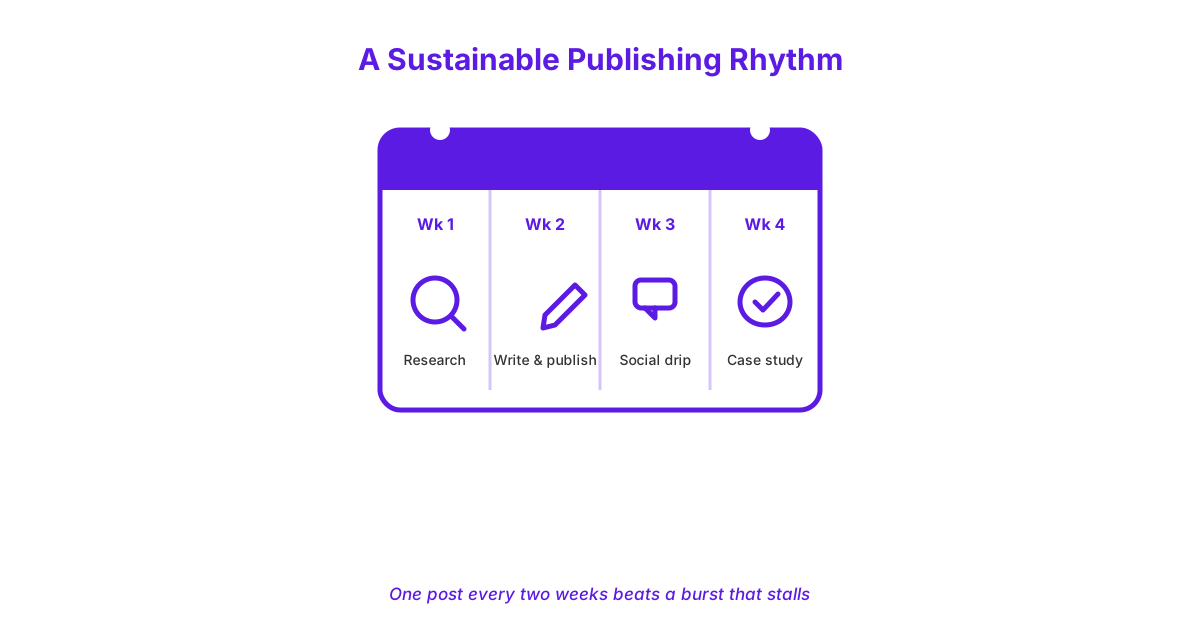
A realistic starting framework for most SMEs is one blog post every two weeks, one case study per month, and two to three social posts per week drawn from that core content. This cadence is sustainable for a business owner or small team juggling content alongside actual operations, unlike an ambitious daily posting schedule that typically collapses within a month. Consistency over a longer period matters far more than frequency in any single week.
A simple week-by-week rhythm might look like: week one for research and an outline, week two for writing and publishing the blog post, with social posts and any case study work happening in the gaps around client work. This spreads the workload thinly enough that it doesn’t compete directly with the demands of running the business day to day.
Batching Content Creation to Save Time
Batching content creation, meaning writing several pieces in one focused session rather than one at a time as each deadline approaches, saves significant time and improves consistency for busy SME owners. Setting aside a single half-day each month to outline or draft three to four pieces at once is far more efficient than trying to squeeze in fifteen minutes of writing several times a week between other tasks. This also produces more coherent content, since ideas connect better when drafted in the same sitting rather than in scattered, interrupted bursts.
Photos and video for case studies or social content can be batched the same way, capturing several months’ worth of material during a single on-site visit or client interaction rather than trying to arrange something new every time you need it.
How Do You Repurpose One Piece of Content Across Channels?
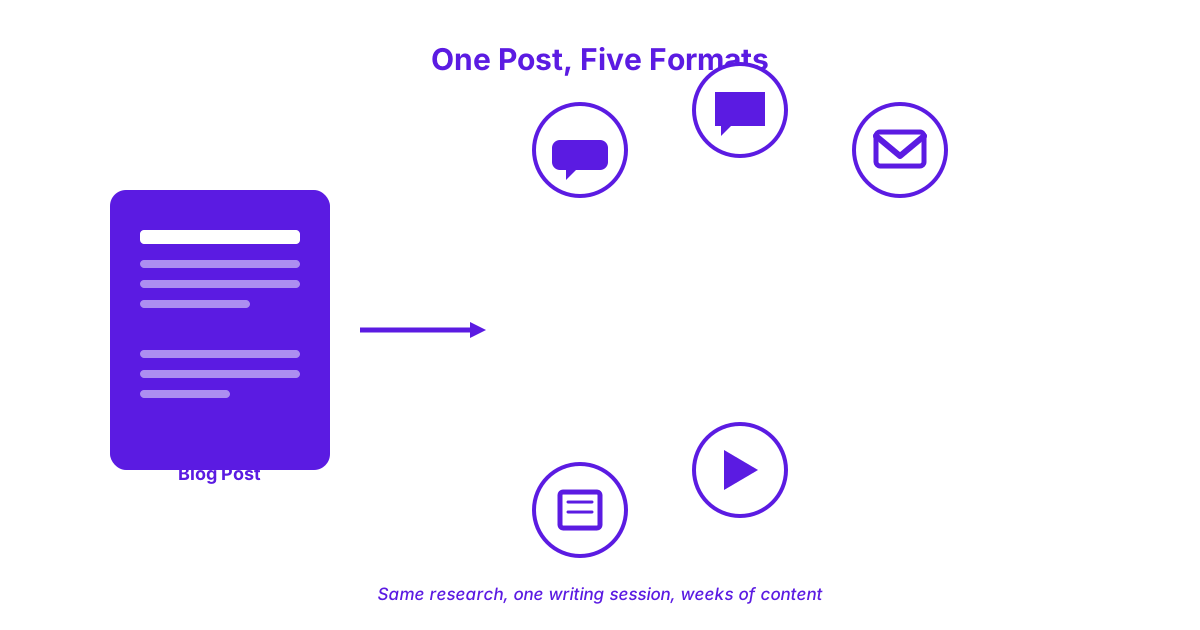
You repurpose one piece of content across channels by breaking a single in-depth blog post into smaller formats suited to each platform, rather than creating entirely new content for every channel. This single-input, multiple-output approach is how small teams produce a consistent content presence without a proportional increase in workload.
Turning a Single Blog Post Into Multiple Formats
A single 1,500-word blog post can realistically be turned into three to five social media posts, one short email newsletter, and a 60 to 90 second video summarising the core point, all from the same research and writing effort. Each social post can highlight one key statistic, tip, or quote from the article, driving interested readers back to the full piece on your website. The email version can simply be a shortened summary with a link through to the complete article, giving your list a reason to click through.
This approach means a single topic researched and written once can realistically generate two to three weeks of content across multiple channels, without needing fresh research each time. If building this kind of repurposing system feels like more than you can manage internally, our content marketing service is built around exactly this kind of efficient, multi-channel content strategy.
How Do You Measure Content Marketing ROI?
You measure content marketing ROI by tracking both traffic and engagement metrics in the short term and business outcome metrics like leads and enquiries over the longer term. Looking at only one type of metric gives an incomplete picture, since traffic without conversions isn’t valuable on its own, but conversions without enough traffic volume rarely happen either.
Traffic and Engagement Metrics That Actually Matter
The traffic and engagement metrics that actually matter for content marketing are organic search visits, average time on page, and scroll depth, since these indicate whether people are genuinely finding and reading your content rather than bouncing immediately. Google Search Console and Google Analytics, both free tools, provide this data without requiring any paid subscription. A steady month-over-month increase in organic visits to your content pages is usually the clearest early signal that your content strategy is working.
Time on page and scroll depth matter because they reveal whether visitors are actually reading your content or leaving within seconds, which traffic numbers alone can’t tell you. Content with high traffic but very low time on page usually signals a mismatch between what the title promised and what the content delivered.
Business Metrics: Leads, Enquiries, and Attribution
The business metrics that actually matter for content marketing ROI are the number of leads or enquiries that can be attributed to content pages, tracked through contact form submissions, phone calls, or a simple “how did you hear about us” question. Setting up basic conversion tracking on your contact form, so you can see which pages visitors read before converting, is essential for connecting content effort to actual business results. Without this step, content marketing can feel like it’s “not working” even when it’s quietly generating enquiries you’re not attributing correctly.
Industry research, such as the Content Marketing Institute’s annual benchmarks report, consistently shows that businesses publishing content regularly generate measurably more leads than those that don’t, reinforcing that this is a proven channel rather than a leap of faith. Attribution doesn’t need to be perfect to be useful; even a simple dropdown on your contact form asking how someone found you provides a rough but genuinely useful signal over time.
What Mistakes Do Irish SMEs Make With Content Marketing?
The most common mistakes Irish SMEs make are publishing inconsistently, ignoring basic SEO, and having no promotion plan once content is published. Each of these individually undermines an otherwise reasonable content effort, and together they explain most of the “we tried content marketing and it didn’t work” stories.
Inconsistency, Ignoring SEO, and No Promotion Strategy
Inconsistency is the most damaging mistake, since a burst of five articles in one month followed by six months of silence fails to build the compounding momentum that makes content marketing valuable in the first place. Google and readers both respond to steady, ongoing publishing far better than sporadic bursts, since consistent activity signals an active, trustworthy business rather than one that gave up. A slower, sustainable pace maintained for a year outperforms an aggressive start that stalls.
Ignoring basic SEO is the second major mistake, since even genuinely excellent content won’t be found if it’s not structured with proper titles, headers, and keyword-appropriate phrasing that matches how people actually search. Content marketing and SEO work together rather than as separate disciplines, and understanding how content and SEO work together early on prevents months of good writing going largely unread. Having no promotion strategy is the third mistake: publishing content and assuming it will be found is rarely enough, since sharing it through email, social channels, and relevant communities is often what gets the first wave of traffic moving.
Should You Use AI to Help With Content Marketing?
Yes, AI can genuinely help with content marketing when used for research, outlining, and first drafts, but it costs you your authentic voice and credibility when used to publish finished content without real editing or personal input. The technology is a legitimate productivity tool, not a replacement for the judgment and experience that make your content worth reading in the first place.
Where AI Genuinely Helps, and Where It Costs You Your Voice
AI genuinely helps with brainstorming topic ideas, creating a first-draft outline, and speeding up research into a subject you already understand but need to organise clearly. Using it to structure your thoughts or produce a rough first pass that you then rewrite in your own voice, with your own specific examples and opinions, is a legitimate and time-saving workflow. This is especially useful for SME owners who know their industry well but find the blank page the hardest part of writing.
AI costs you your voice and credibility when it’s used to generate and publish finished articles with no meaningful editing, since generic AI writing is increasingly easy for both readers and Google’s systems to detect and discount. Published content that reads as generic, ungrounded in your specific business and experience, fails to build the trust that is the entire point of content marketing in the first place. The safest rule is to use AI heavily in the early drafting stages and add your genuine expertise, specific numbers, and real examples before anything gets published.
Content Marketing for Irish SMEs at a Glance
The table below summarises the content types covered in this guide, what each is best suited for, and a realistic time investment for a small business team.
| Content Type | Best For | Time Investment |
|---|---|---|
| Blog Posts | Search visibility and answering direct customer questions | 2 to 4 hours per post |
| Case Studies | Building trust through proof of results | 1 to 2 hours per case study |
| Short-Form Video | Social discovery and personality-driven trust | 30 to 60 minutes per video |
| Email Newsletter | Nurturing existing contacts and repeat business | 30 minutes per issue, repurposed from blog content |
| Social Media Posts | Distribution and driving traffic back to core content | 15 to 20 minutes per batch of posts |
Frequently Asked Questions
What is content marketing in simple terms?
Content marketing in simple terms means creating genuinely useful articles, videos, or guides that earn a customer’s attention and trust, rather than paying to interrupt them with an advertisement. It works by answering real questions your potential customers already have, which builds trust and search visibility at the same time.
How much does content marketing cost for a small business in Ireland?
Content marketing for a small Irish business typically costs between a few hours of internal time per month or, if outsourced, roughly 400 to 1,000 per month depending on volume and quality. The cost varies significantly based on whether you’re writing content yourself, hiring a freelancer, or working with an agency that handles strategy, writing, and promotion together.
How often should an SME publish content?
Most SMEs should aim to publish one thorough blog post every two weeks, alongside two to three social media posts per week drawn from that core content. Consistency at a sustainable pace matters far more than frequency, since sporadic bursts followed by long silences undermine the compounding benefit content marketing depends on.
Does content marketing help with SEO?
Yes, content marketing directly helps SEO by giving Google fresh, relevant pages to index and rank for the specific questions your potential customers are searching for. Regularly published, well-structured content is one of the strongest signals of an active, authoritative website that search engines reward with better visibility over time.
How long does it take to see results from content marketing?
Most businesses start seeing meaningful traffic and enquiries from content marketing within three to six months of consistent publishing. Results build gradually rather than appearing overnight, and the businesses that see the strongest results are typically the ones that keep publishing consistently through this initial slower period rather than stopping early.
Content marketing rewards businesses that start simple and stay consistent far more than those chasing a perfect strategy from day one. If you’d like help building a content system that actually fits your time and budget, get in touch with Magnitu Digital and we’ll help you build a plan you can realistically stick to.
