SEO vs Google Ads: Which Should You Invest In First?
Most articles on this exact question conclude with “do both eventually” and never actually answer the sequencing question business owners are asking. Knowing that SEO and Google Ads both matter long-term doesn’t help you decide where to put your first 500 or 1,000 euro this month. This guide gives you a real decision framework based on your specific business stage and budget, calibrated for Irish SMEs rather than borrowed from generic global marketing advice.
What’s the Real Difference Between SEO and Google Ads?
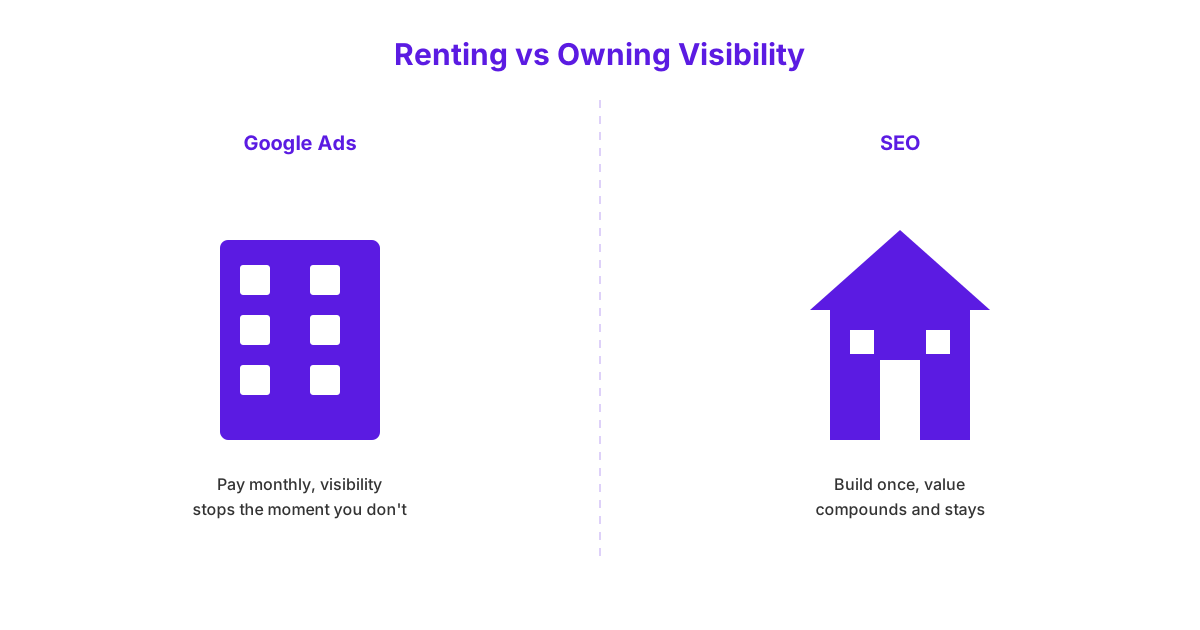
The real difference between SEO and Google Ads comes down to renting versus owning: Google Ads rents visibility for exactly as long as you keep paying, while SEO builds owned visibility that compounds and persists over time. This distinction is the foundation for every sequencing decision covered in this guide, so it’s worth stating plainly before moving into the harder question of timing and budget. Neither channel is better in the abstract, but they behave completely differently as your business grows and your budget changes.
Which Should a New Business Invest in First?
A new business should usually invest in Google Ads first, since it delivers immediate market feedback and leads while your website still lacks the domain authority needed for SEO to work effectively. This isn’t a compromise choice, it’s the sequencing that matches what a new business actually needs most in its earliest months.
Why Early-Stage Irish Businesses Should Usually Start With Ads
Early-stage Irish businesses should usually start with Google Ads because a brand-new website has essentially no domain authority yet, meaning even excellent SEO work takes months to produce any meaningful ranking movement regardless of how well it’s executed. Google Ads, by contrast, can put your business in front of paying customers within days of launching a campaign, giving you real, immediate feedback on whether your offer and pricing actually work in the market. A new business without this feedback loop is often making guesses about demand for months longer than it needs to.
This early period is also when testing which specific keywords and offers actually convert matters most, since Google Ads gives you fast, direct data on which search terms produce enquiries and which don’t. A new landscaping business in Athlone, for example, can test within two or three weeks whether “garden maintenance Athlone” or “lawn care Athlone” converts better, data that would take SEO many months to reveal through ranking movement alone. This same keyword and messaging data then becomes genuinely valuable input for the SEO content you’ll eventually build once your business is ready to shift focus.
When Should a Growing Business Start Shifting Budget Toward SEO?
A growing business should start shifting budget toward SEO once it has clear evidence of product-market fit and a proven, repeatable customer acquisition process worth building long-term visibility around. This shift isn’t about abandoning ads entirely, it’s about recognising the point where compounding, owned visibility becomes a better use of incremental budget than continuing to rent 100% of your visibility through paid clicks.
Signs You’ve Found Product-Market Fit and Are Ready to Build Organic
Signs you’ve found product-market fit include a consistent, predictable conversion rate from your Google Ads campaigns over at least two to three months, a clear understanding of which specific services or products actually drive the most enquiries, and enough repeat or referral business that you’re not solely dependent on paid clicks for every new customer. A business that’s been running ads for four to six months and can now say with confidence “our 800 euro monthly ad spend reliably produces around 12 enquiries” has the kind of stable, proven data that makes SEO investment a much lower-risk decision than starting from a completely untested offer. Without this proven foundation, SEO content risks being built around messaging and keywords that haven’t actually been validated against real market response.
This is also the point where the keyword and conversion data gathered during your ads-first phase becomes genuinely valuable, since you’re no longer guessing which topics and search terms to build organic content around, you already know from real campaign data. If you’re at this stage and ready to start building durable, compounding visibility, it’s worth looking at our SEO service as building organic visibility around exactly the offers and keywords your ads data has already proven work.
What Does the Budget Split Look Like at Each Stage of Growth?
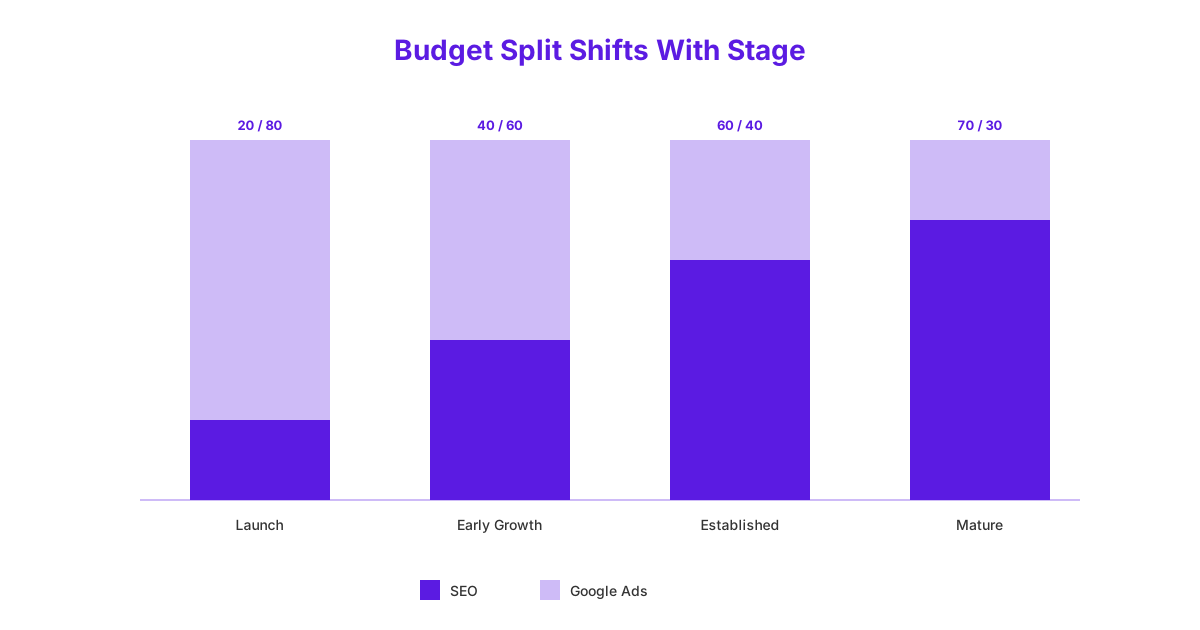
The right budget split between SEO and Google Ads shifts predictably as an Irish SME moves from launch through to established, with early stages weighted heavily toward ads and later stages shifting more toward SEO as owned visibility compounds. The table below shows realistic splits for Irish SME budgets at each stage, using figures appropriate to small business marketing spend rather than larger enterprise-scale numbers.
| Business Stage | Typical Monthly Marketing Spend | Recommended SEO-Ads Split | Why |
|---|---|---|---|
| Launch (0 to 6 months) | 400 to 800 euro | 20% SEO, 80% Ads | Needs immediate leads and market feedback |
| Early Growth (6 to 18 months) | 800 to 1,500 euro | 40% SEO, 60% Ads | Product-market fit emerging, worth building organic in parallel |
| Established Growth (18+ months) | 1,200 to 2,500 euro | 60% SEO, 40% Ads | Compounding organic visibility reduces reliance on paid clicks |
| Mature (steady, repeat demand) | 1,500 to 3,000-plus euro | 70% SEO, 30% Ads | Ads used selectively for specific offers rather than as primary channel |
What Does 1,000 Euro a Month Actually Get You in SEO Versus Google Ads?
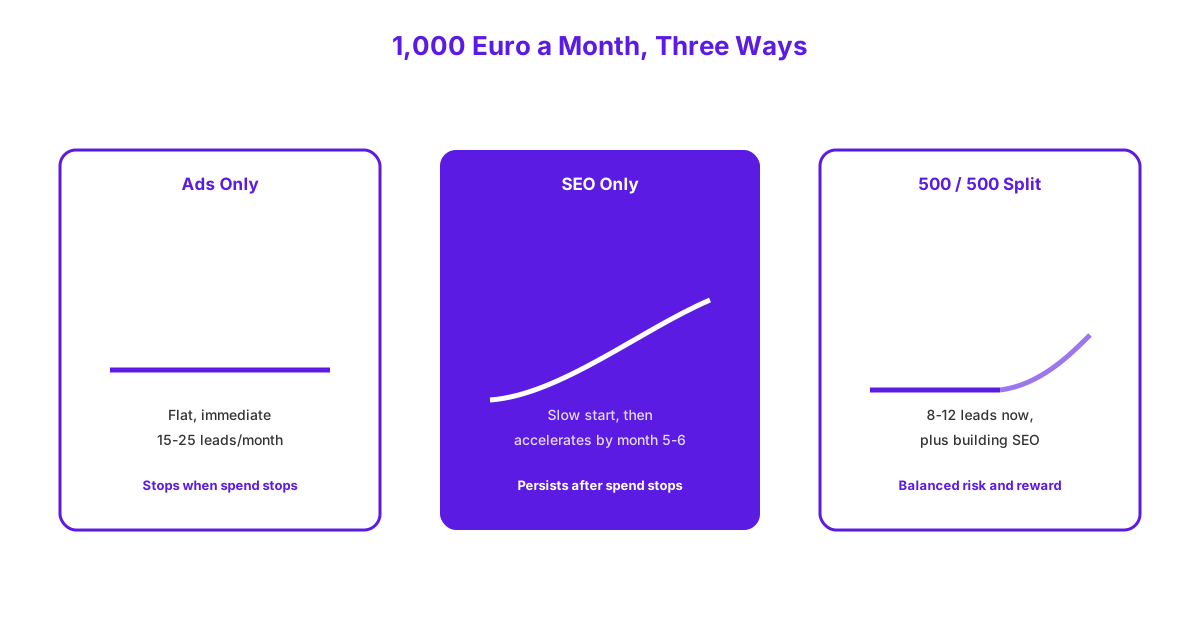
A thousand euro a month produces very different outcomes depending on whether it’s spent entirely on Google Ads, entirely on SEO, or split between both, and understanding these different shapes of return is central to making a good sequencing decision. The three scenarios below use the same monthly budget to make the tradeoffs directly comparable.
Scenario A: 1,000 Euro a Month on Google Ads Only
A thousand euro a month spent entirely on Google Ads typically produces immediate, predictable lead flow from the first month, with performance largely flat from month one through month twelve since paid traffic doesn’t compound over time. A business in a moderately competitive local service category might see roughly 15 to 25 enquiries per month at this spend level, depending on industry cost per click, with that volume staying roughly consistent as long as the budget continues. The moment this spend stops, the enquiry flow stops just as quickly, since none of this visibility is owned or retained by the business.
This scenario suits a business needing reliable, immediate lead volume right now, or one still validating whether its offer and market fit are solid enough to justify longer-term investment elsewhere. The predictability is genuinely valuable, but it comes with zero residual value once the spend ends.
Scenario B: 1,000 Euro a Month on SEO Only
A thousand euro a month spent entirely on SEO typically produces very little measurable lead flow in months one through three, followed by gradually accelerating results from month four onward as content and technical improvements begin to compound. A business following this path might see minimal enquiries directly attributable to SEO in the first quarter, then a meaningful uptick beginning around month five or six as rankings for genuinely useful content start to establish. By month twelve, this same spend often produces a comparable or greater enquiry volume than the equivalent ad spend, but with the critical difference that this visibility persists even if the monthly spend were to stop.
This scenario suits a business with enough existing revenue or reserves to comfortably absorb several months of limited return before SEO’s compounding effect kicks in. It’s a considerably riskier choice for a brand-new business without existing cash flow to sustain that early period.
Scenario C: 500 Euro SEO Plus 500 Euro Ads Split
Splitting the same thousand euro evenly between SEO and Google Ads typically produces a more moderate but immediate lead flow from ads, generating perhaps 8 to 12 enquiries per month from that half of the budget, while the SEO half builds toward its own compounding contribution over the following six to twelve months. This scenario provides the psychological and financial safety of immediate leads while still building the owned, compounding asset that pure ad spend never creates. Many Irish SMEs find this split scenario the most comfortable starting point once they’ve moved past the earliest launch phase, since it avoids the all-or-nothing risk of either pure scenario.
The tradeoff is that neither channel gets the full, undivided budget needed to move as fast as it could individually, meaning both the immediate lead volume and the eventual SEO payoff are more modest than either single-channel scenario at full budget. This is a reasonable, balanced middle path rather than a compromise that undermines both channels.
Is There a Scenario Where SEO Should Always Come First?
Yes, SEO should come first regardless of business stage in categories where paid search cost per click has become so expensive that Google Ads is barely viable even for an established, well-funded business. This is a genuine exception to the earlier ads-first recommendation for new businesses, and it applies specifically to a small number of highly competitive local categories.
Competitive Local Categories Where Paid Search Is Prohibitively Expensive
Competitive local categories such as personal injury law, family law, and certain high-value financial services frequently see cost per click figures so high that even a meaningful budget produces only a handful of clicks per day, making Google Ads a poor primary strategy even for well-resourced businesses. In these specific categories, a new business is often better served starting with a smaller, tightly targeted ads budget purely for immediate lead testing, while directing the bulk of available budget toward SEO from day one, accepting the slower payoff in exchange for genuinely viable long-term visibility. Independent research on search click behaviour consistently shows that organic results capture a significantly larger share of total clicks than paid ads across most categories, reinforcing that organic visibility remains valuable and worth pursuing even in categories where paid search has become prohibitively expensive.
This exception is genuinely rare rather than a loophole to justify skipping ads broadly. Most Irish SME categories, including most local trades, retail, and general professional services, don’t face cost per click figures extreme enough to warrant this reversed sequencing, and businesses in more typical categories should default to the ads-first approach covered earlier. Businesses genuinely unsure whether their specific category falls into this exception are usually better off testing a modest managed PPC campaign briefly to see actual cost per click data firsthand, rather than assuming based on general industry reputation alone.
What If a Competitor Is Already Beating You on Both Channels?
If a competitor is already beating you on both SEO and Google Ads, the right response is to deliberately prioritize catching up on one channel first rather than spreading a limited budget thinly across both simultaneously. This is a genuinely common and understandably stressful situation, but attempting to compete on both fronts at once with a modest budget usually means losing on both, since neither channel receives enough concentrated investment to make real progress against an established competitor.
The more effective approach is choosing the channel where your competitor’s advantage is more vulnerable or slower to defend. If a competitor’s SEO position rests on years of accumulated content and backlinks, that’s a genuinely difficult, slow gap to close quickly, whereas their Google Ads position can be directly and immediately contested simply by matching or exceeding their bid on the same keywords starting today. Conversely, if a competitor is spending heavily on ads but has genuinely thin, poorly structured website content, that’s a more winnable and faster opportunity to overtake them on SEO than trying to out-bid their advertising budget directly.
Choosing deliberately, based on where the competitor is genuinely weaker rather than trying to match their strength everywhere at once, gives a smaller budget a realistic chance of producing a genuine competitive advantage on at least one front within a reasonable timeframe.
What’s the Biggest Mistake Businesses Make With This Decision?
The biggest mistake businesses make with this decision is treating it as a single, permanent choice rather than a sequencing decision that should evolve deliberately as the business grows. A business that decided two years ago to focus purely on Google Ads because it was a brand-new company at the time, and never revisited that decision as it matured, is very likely leaving significant compounding value on the table by continuing to rent 100% of its visibility indefinitely.
This mistake runs in both directions. A business that shifted heavily toward SEO early, before it had validated its offer or built any reliable revenue, sometimes finds itself under-resourced for the months of limited return that come before SEO’s compounding effect kicks in, having skipped the faster feedback loop that ads would have provided first. The businesses that get this right treat the choice as a living decision, reviewed roughly every six months against the stage-based framework covered earlier in this guide, rather than a one-time decision made at launch and never reconsidered as circumstances change.
Revisiting this decision periodically costs nothing beyond an honest look at your current stage, existing customer data, and budget, yet it’s the single highest-leverage adjustment most Irish SMEs are missing in their current marketing approach.
SEO vs Google Ads Sequencing at a Glance
The table below condenses the core sequencing framework covered throughout this guide into a single scannable reference.
| Business Stage | What to Prioritize | Why |
|---|---|---|
| Brand New | Google Ads | Immediate feedback, no domain authority yet for SEO to work |
| Product-Market Fit Emerging | Begin shifting toward SEO | Proven offer and keyword data make SEO investment lower risk |
| Established, Steady Demand | SEO as primary channel | Compounding visibility reduces long-term reliance on paid clicks |
| Extremely High CPC Category | SEO from the start | Paid search may be prohibitively expensive regardless of stage |
| Behind Competitors on Both | Pick one channel deliberately | Concentrated effort beats spreading thin across both |
Frequently Asked Questions
Should a brand-new business start with SEO or Google Ads?
A brand-new business should generally start with Google Ads, since a new website lacks the domain authority needed for SEO to produce meaningful results quickly, while ads provide immediate market feedback and leads. This isn’t a permanent choice, it’s the right starting sequence that should shift as the business validates its offer and grows.
How do I know if my business has outgrown a paid-search-only strategy?
Your business has likely outgrown a paid-search-only strategy once you have several months of consistent, predictable conversion data and a clear sense of which keywords and offers actually work. At this point, that proven data becomes valuable input for building SEO content around what’s already validated, rather than guessing which topics to target.
Can I do SEO and Google Ads on a small budget at the same time?
Yes, splitting a small budget between SEO and Google Ads, such as an even split of a thousand euro monthly budget, is a reasonable middle path once a business has moved past its earliest launch phase. This approach provides some immediate lead flow from ads while still building compounding organic visibility, though neither channel progresses as quickly as it would with a full, undivided budget.
How long does it take for SEO to start outperforming paid ads?
SEO typically starts producing comparable or greater lead volume than an equivalent ad spend around month five or six of consistent investment, based on realistic Irish SME budgets and timelines. Results before this point are usually minimal, which is why businesses need either existing cash flow or continued ad spend to sustain the earlier months while SEO builds toward this crossover.
Should I keep running Google Ads once my SEO is working well?
Yes, most established businesses should keep running some level of Google Ads even once SEO is working well, though usually at a reduced share of overall budget rather than as the primary channel. Ads remain useful for promoting specific offers, testing new services, or maintaining visibility for a small number of highly competitive terms that organic rankings haven’t fully captured.
Deciding which channel to invest in first comes down to being honest about your specific business stage, not following a generic rule that ignores where you actually are right now. If you’d like help mapping out the right sequence and split for your specific budget and stage, get in touch and talk to us about your marketing budget.
