What Is AI SEO? How to Optimize for ChatGPT, Gemini and Claude
People are increasingly asking ChatGPT, Gemini, and Claude questions directly instead of typing them into Google and clicking through a list of results. If your content isn’t the one quoted in that AI-generated answer, you don’t exist to that customer, no matter how good your product or service actually is. This guide explains, in plain language, what AI SEO actually is and exactly how to structure your pages so AI models cite them, with no coding background required.
What Is AI SEO (Also Called AEO or GEO)?
AI SEO is the practice of structuring content so AI models quote it directly in their answers, rather than simply ranking it in a traditional list of search results. The same underlying idea goes by several names depending on who’s talking about it: Answer Engine Optimization (AEO) and Generative Engine Optimization (GEO) are the two most common alternative terms, and both describe essentially the same discipline as AI SEO.
The core shift this represents is moving from “being findable” to “being quotable.” Traditional SEO succeeds when your page appears near the top of a results list and a person clicks through to read it. AI SEO succeeds when an AI system reads your page, extracts a specific fact or answer from it, and presents that answer directly to the user, often without any click happening at all.
This isn’t a replacement discipline that makes traditional SEO obsolete. It’s an additional layer of structure and clarity on top of the SEO fundamentals you likely already understand, applied with a different end goal in mind: being the source an AI model trusts enough to cite by name or quote directly.
How Is AI SEO Different From Traditional SEO?
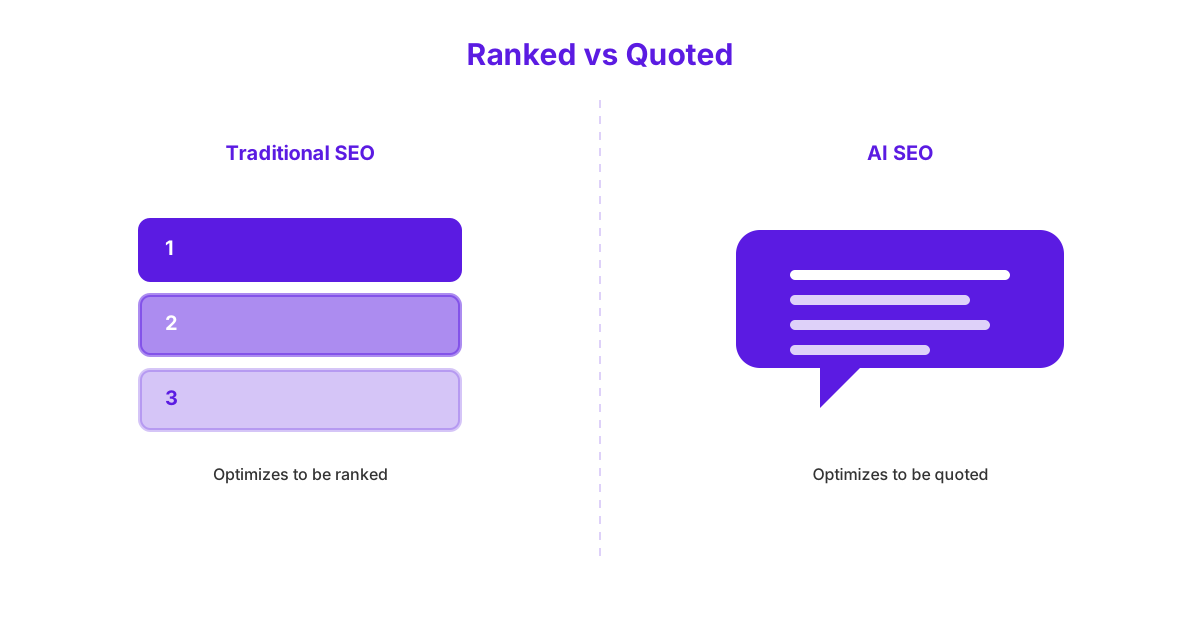
AI SEO differs from traditional SEO in what it’s actually optimizing for: traditional SEO optimizes to be ranked, while AI SEO optimizes to be quoted. This distinction changes how you should write, structure, and phrase almost everything on a page.
SEO Optimizes to Be Ranked, AI SEO Optimizes to Be Quoted
Traditional SEO succeeds when a page ranks highly enough in search results that a person sees it and chooses to click, meaning the goal is largely about visibility and relevance signals. AI SEO succeeds when an AI model extracts a specific, standalone answer from your page and presents it directly within a generated response, meaning the goal is about clarity and extractability rather than visibility alone. A page can rank well in traditional search while still being completely unquotable by an AI model, if its actual answers are buried in vague, hedging language.
Content that gives a direct, self-contained answer gets cited by AI models. Content that hedges, qualifies, or buries its point three paragraphs deep does not, regardless of how well-researched or accurate that content actually is. This is the single most important practical difference to understand, since it changes how you should write the opening of nearly every section on your site.
Why the Click Is Disappearing
The click is disappearing because AI-generated answers increasingly satisfy a user’s question directly within the chat interface, removing the need to visit the source website at all. Google’s own AI Overviews feature, along with ChatGPT, Gemini, Claude, and Perplexity, now routinely answer factual and comparative questions in full within the response itself. A user asking “what’s the best time to post on Instagram in Ireland” may get a complete, satisfying answer without ever seeing your website’s name, let alone clicking through to it.
This shift means visibility inside the AI-generated answer, even without a click, is increasingly valuable in its own right, since brand recognition and trust can be built simply through being the cited source. Businesses that only measure success through website traffic are likely to miss this entirely, since a citation with zero clicks can still meaningfully shape a customer’s decision.
Can AI Models Even Find Your Content in the First Place?
Yes, but only if your website’s technical setup actually allows it, since several common configurations silently block AI crawlers from reading your content at all. A page can be perfectly written for AI SEO and still never get quoted if the underlying site is technically inaccessible to the AI systems trying to read it.
What Blocks ChatGPT, Gemini, and Claude From Reading Your Site
The most common thing blocking AI models from reading your site is a crawler access file that explicitly disallows AI-specific crawlers, even while allowing standard search engine crawlers like Googlebot. Every website has a small instructions file that tells automated visitors, including both search engines and AI systems, which parts of the site they’re allowed to read. Some websites, often without realising it, have this file configured to block AI-specific crawlers such as GPTBot or Google-Extended, while still allowing traditional search engine crawlers through.
Beyond this specific file, heavy reliance on JavaScript to load core page content can also prevent some AI crawlers from seeing your actual text, since not every crawler renders JavaScript the same way a browser does. If your key content only appears after a script runs, rather than existing directly in the page’s underlying code, some AI systems may see a blank or incomplete page. This is a technical detail worth flagging to a developer directly, since diagnosing it usually requires looking at the site’s actual code rather than just its visible design.
Why Clean Technical Structure Still Matters
Clean technical structure still matters for AI SEO because AI crawlers rely on the same underlying page structure, such as headings, paragraphs, and lists, to understand what a page is actually about and where the key answers live. A page with a messy structure, where the actual answer to a question is scattered across multiple disconnected paragraphs, is much harder for an AI model to extract cleanly compared to one with a clear heading followed immediately by a direct answer. This is the same structural discipline good SEO has always rewarded, simply applied with a sharper focus on extractability.
Fast page load times and mobile compatibility remain relevant too, since a slow or broken page reduces the likelihood that any crawler, AI or otherwise, processes it fully before moving on. None of this requires reinventing your website from scratch, but it does mean technical basics that may have been treated as “nice to have” for years are now directly tied to whether AI systems can read your content at all.
How Do You Write Content That AI Models Actually Quote?
You write content that AI models actually quote by leading with a direct, self-contained answer, phrasing headings as questions, and grounding every claim in a specific number or fact. These three habits, applied consistently across a page, are the single biggest lever available for improving how often your content gets cited.
Lead With a Direct, Self-Contained Answer
Leading with a direct, self-contained answer means the very first sentence after any heading should fully answer the question that heading poses, without requiring the reader to continue into the next paragraph to understand it. An AI model scanning a page for something to quote will favour a sentence that stands alone and makes complete sense in isolation over one that depends on context from surrounding sentences. This means cutting the throat-clearing that traditional web writing often opens with, such as “when it comes to choosing a web design package, there are many factors to consider,” and instead starting directly with the actual answer.
This habit feels unnatural at first if you’re used to easing a reader into a topic gradually. AI SEO rewards the opposite instinct: state the conclusion first, then use the following sentences to add nuance, context, and supporting detail. Every heading on a page should be treated as a question an AI model might be asked, with the very next sentence written as the direct, quotable answer to it.
Phrase Headings as Questions, Not Statements
Phrasing headings as questions rather than statements matters because AI models are frequently answering literal questions typed or spoken by a user, and a heading phrased as that same question creates a much stronger match between the query and your content. A heading like “Website Maintenance Costs” is a topic label, not a question, and gives an AI model less to directly match against a user’s actual query. A heading rewritten as “How Much Does Website Maintenance Cost?” mirrors the exact phrasing a user or AI system is likely to be working with, making the connection between question and answer far more direct.
Here’s a concrete before and after example. Weak, hedging version: “Some Thoughts on Response Times” followed by “Response times can vary depending on a number of factors and businesses should generally try to respond as quickly as is reasonably possible.” Direct, quotable version: “What’s a Good Customer Response Time?” followed by “A good customer response time is under 24 hours for email and under 2 hours for live chat or social media messages.” The second version gives an AI model an actual fact to extract and cite, while the first gives it nothing concrete to work with at all.
Ground Every Claim in a Specific Number or Stat
Grounding every claim in a specific number or fact matters because AI models preferentially extract and cite concrete, verifiable information over vague, general statements that could mean almost anything. A sentence like “SEO can take a while to show results” gives an AI system nothing quotable, since it’s too imprecise to state as a fact. A sentence like “SEO typically takes three to six months to show measurable ranking improvements” gives a specific, citable claim that an AI model can confidently repeat as a direct answer to a user’s question.
This doesn’t mean fabricating false precision where none genuinely exists. It means doing the work to find or establish a real number, timeframe, or percentage wherever one is available, rather than defaulting to a vague qualifier out of caution. If you’re building this kind of specificity into your content consistently across a whole site, it’s worth looking at how we approach SEO and content together, since this level of precision needs to be maintained page after page to compound into a real AI-citation advantage.
What Role Does Schema Markup Play in AI SEO?
Schema markup plays a supporting but meaningful role in AI SEO by giving AI models a clearly labelled, machine-readable version of your page’s key facts, separate from the prose a human reader sees. This doesn’t replace the need for well-written, direct content, but it does reinforce and clarify that content for machine readers in a way plain text alone cannot.
Which Schema Types Matter Most (FAQPage, Article, HowTo)
The schema types that matter most for AI SEO are FAQPage, Article, and HowTo, since these directly map to the kind of question-and-answer content AI models are most often extracting and citing. FAQPage schema explicitly labels a question and its answer as a matched pair, which is about as close as you can get to handing an AI model a ready-made citation. Article schema labels core metadata like the author, publish date, and headline, helping AI systems establish basic trust and recency signals about a piece of content.
HowTo schema is particularly valuable for any content involving sequential steps, since it explicitly labels each step in order, which suits how AI models often need to present process-based answers. None of these require you to write any code yourself. Once you know which pages should carry which schema type, this becomes a straightforward, well-documented task for a developer to implement.
What Schema Actually Does for an AI Model
Schema markup gives an AI model a structured, unambiguous confirmation of facts that might otherwise need to be inferred from prose, reducing the chance of misreading or misattributing information from your page. Without schema, an AI system reading a page has to interpret meaning from sentence structure and context, which works well most of the time but leaves room for error, particularly on pages with complex or unusually structured content. With schema in place, key facts such as a question’s exact answer, a step’s exact position in a sequence, or an article’s actual publish date are stated explicitly rather than left to inference.
For a technical reference your developer can work from, schema.org and Google’s Search Central documentation both outline the specific markup types AI systems and search engines currently support. Handing this documentation directly to whoever manages your website’s code is the most efficient way to get schema implemented correctly without needing to understand the underlying syntax yourself.
Does AI SEO Work Differently on ChatGPT, Gemini, and Claude?
Yes, AI SEO works somewhat differently across ChatGPT, Gemini, and Claude, since each platform sources and presents information using a different underlying approach. Understanding these differences helps explain why a page might get cited readily by one AI system and rarely by another.
How Each Platform Sources and Presents Answers
Gemini is closely tied to Google Search’s existing index, meaning strong traditional SEO performance and Gemini visibility are more closely linked than with other AI platforms, since Gemini frequently draws on the same underlying search infrastructure Google already uses for ranking. Perplexity places a strong emphasis on visible, clickable citations directly within its answers, making it one of the more transparent platforms about exactly which sources it’s drawing from for any given response. ChatGPT’s browsing behaviour, when web browsing is active, tends to favour clearly structured, recently updated pages with unambiguous factual statements, similar to the direct-answer approach this article recommends throughout.
Claude similarly favours clearly structured, well-sourced content, and tends to weigh the credibility and specificity of a source’s claims heavily when deciding what to reference in a response. Rather than treating any one platform as the definitive target to optimize for, the safest strategy is writing content that satisfies the shared underlying principle across all of them: direct answers, clear structure, and specific, verifiable claims consistently outperform vague, hedging content regardless of which AI system is doing the reading.
How Do You Turn an Existing Page Into an AI-SEO-Friendly Page?
You turn an existing page into an AI-SEO-friendly page by identifying the specific question it should answer, restructuring its opening to answer that question directly, and then applying the same discipline consistently across every heading on the page. This process works on existing content and doesn’t require starting from scratch or rebuilding your website.
A Step-by-Step Process You Can Follow Without a Developer
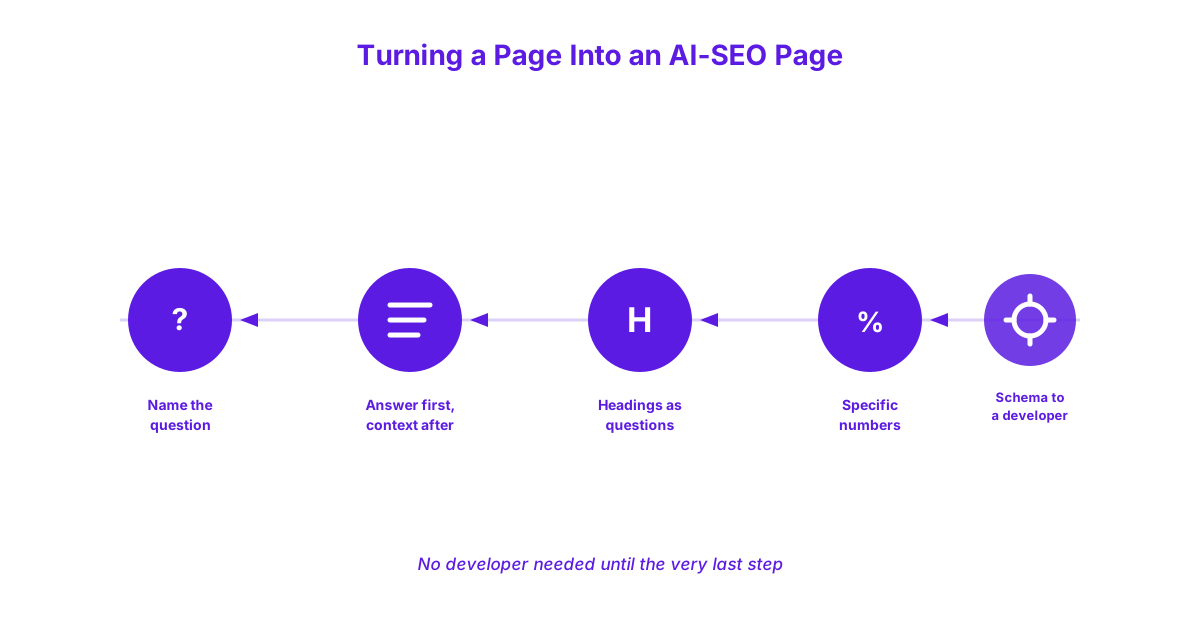
Start by naming the exact question each major section of the page is meant to answer, written out as a literal question the way a customer might type or speak it. Next, restructure the opening sentence under each heading so it directly and completely answers that question, moving any necessary context or nuance to the sentences that follow rather than before. Then, go back through and rephrase every heading itself into a question format if it isn’t already, matching the exact language a real customer would use rather than an internal or marketing-style label.
After that, review every claim on the page and replace vague qualifiers with specific numbers, percentages, or timeframes wherever you can genuinely support them with real information. This restructuring process is fundamentally a content strategy exercise rather than a technical one, and it’s worth treating it as part of a structured content strategy rather than a one-off fix applied to a single page in isolation. Once the content itself has been restructured this way, the final step, adding or updating schema markup to match the new structure, can be handed directly to a developer without you needing to understand the underlying code yourself.
What Mistakes Undermine AI SEO Efforts?
The most common mistakes that undermine AI SEO efforts are hedging language, missing schema markup, and unintentionally blocking AI crawlers through technical misconfiguration. Each of these individually reduces your chances of being cited, and most sites currently have at least one of these problems without realising it.
Hedging Language, Missing Schema, and Ignoring Crawler Access
Hedging language, such as “results may vary” or “this can depend on several factors” used as a substitute for an actual answer, gives AI models nothing concrete to extract, no matter how accurate or well-intentioned the caution behind it is. This habit is deeply ingrained in traditional web copywriting, which often prioritises sounding safe and balanced over sounding direct, and unlearning it takes deliberate effort across an entire site rather than a single page. Missing schema markup is the second major mistake, since it leaves AI models to infer structure and meaning from prose alone, increasing the chance your content gets misread or simply passed over in favour of a more clearly labelled competitor.
Ignoring crawler access is the third and often most overlooked mistake, since a business can spend months restructuring its content for AI SEO while an unnoticed crawler block silently prevents any AI system from ever reading the improved version. Checking crawler access should be one of the very first steps taken, not an afterthought addressed once content work is already underway, since fixing content that AI systems can’t reach in the first place produces no benefit at all.
AI SEO at a Glance
The table below summarises the core elements of AI SEO covered in this guide and why each one matters.
| AI SEO Element | What It Does | Why It Matters |
|---|---|---|
| Direct, Self-Contained Answers | Gives AI models a quotable sentence with no missing context | Increases likelihood of direct citation |
| Question-Phrased Headings | Matches how users actually ask AI systems and Google | Strengthens the match between query and content |
| Specific Numbers and Stats | Replaces vague claims with concrete, citable facts | AI models favour specific, verifiable information |
| Crawler Access | Allows AI systems to actually read your site’s content | Without it, no other AI SEO work has any effect |
| FAQPage, Article, HowTo Schema | Labels facts explicitly for machine readers | Reduces ambiguity and reinforces prose content |
| Clean Technical Structure | Clear headings, fast load times, minimal JavaScript reliance | Makes content easier for AI crawlers to parse fully |
Frequently Asked Questions
Is AI SEO the same as traditional SEO? No, AI SEO is not the same as traditional SEO, though the two share significant overlap and work well together. Traditional SEO optimizes primarily for ranking position in a results list, while AI SEO optimizes for being directly quoted within an AI-generated answer.
Do I need to rewrite my entire website for AI SEO?
No, you don’t need to rewrite your entire website for AI SEO, since the same core techniques, direct answers, question-phrased headings, and specific claims, can be applied incrementally to existing pages one at a time. Prioritising your highest-traffic or highest-value pages first is a more realistic approach than attempting a full site rewrite all at once.
Does AI SEO replace the need for good content? No, AI SEO does not replace the need for good content, and in fact depends entirely on it, since an AI model can only quote a genuinely accurate, useful answer if that answer actually exists somewhere on your page. AI SEO is a structural and phrasing discipline applied on top of solid underlying content, not a substitute for having real expertise and accurate information to share in the first place.
How long does it take to see results from AI SEO?
Results from AI SEO can appear faster than traditional SEO in some cases, since restructuring an existing page’s headings and opening sentences doesn’t require building new rankings from scratch the way new content typically does. However, consistent, measurable citation tracking across AI platforms is still an emerging practice, and most businesses should expect a few months of restructuring and monitoring before drawing firm conclusions about impact.
Can small businesses realistically compete for AI citations against bigger sites?
Yes, small businesses can realistically compete for AI citations against bigger sites, since AI models prioritise clear, specific, well-structured answers over domain size or brand recognition alone. A small business with a precisely written, well-structured answer to a specific question can be quoted just as readily as a much larger competitor whose content on the same topic is vague or poorly structured.
AI SEO is still a genuinely new discipline, and the businesses that adopt these habits now, before it becomes standard practice, stand to gain a real head start in how AI systems represent them to potential customers. If you’d like help restructuring your existing content and setting up the technical pieces correctly, talk to our team about AI SEO and we’ll help you build a plan around it.
